Per the OCOH Fund legislation, the Controller’s Office must report to the Board of Supervisors annually on the revenue and expenditures of the OCOH Fund. Each Annual Report describes how the City budgeted and expended the OCOH Fund over the lifetime of the Fund, with a focus on expenditures for the most recent fiscal year.
This glossary page provides definitions for terms and programs supported with OCOH Fund revenues over time to help readers understand details and context within each Annual Report.
Budget and Finance
Allocated Costs
This term refers to an allocated proportion of the cost to administer the services funded by OCOH, including information and technology, human resources, database and data management, finance and administration and other program supports. In most cases, the OCOH Fund is not the only source of funding for programs described here, and the allocation of administrative costs to run these programs accounts for mixed sources.
Expenditures:
- Total Expenditures – Each Annual Report includes OCOH expenditure data for the most recent fiscal year, the prior fiscal year, and total cumulative expenditures since the first year of the Fund in fiscal year 2020-2021.
- Operating Expenditures – Funds that cover the day-to-day program operations. Operations spending is typically ongoing, but can fluctuate year-to-year as new programs are implemented and/or programs wind down.
- Acquisition Expenditures – Funds for a capital purchase, e.g., buying and/or renovating a building to serve as housing, a treatment facility, or services site. Acquisition funding is typically one-time or project-based, and therefore, more likely to fluctuate from year-to-year.
Remaining Balance
Represents the difference between budgeted funds and actual expenditures during the fiscal year and is an indication of funds that may be available at the end of the fiscal year. However, Remaining Balance includes funds that are reserved to address gaps between revenue and expenditure. City departments also leverage the remaining balance funds for future year spending plans. Therefore, remaining balance figures are often tied to future uses and may not represent unallocated funds.
Total Budget
The total budget represents the total cumulative funding appropriated to each program area of the OCOH Fund since the first year of the Fund in fiscal year 2020-2021.
Permanent Housing Programs
Permanent Housing is the largest service area of the Our City, Our Home (OCOH) Fund. At least 50% of the Fund must be appropriated for this service area. The OCOH Fund can be used for acquiring, constructing, rehabilitating, or leasing buildings to provide permanent housing for people experiencing homelessness. The funding for Permanent Housing programs must be appropriated as follows:
- 55% for the general population (adults)
- 25% for families
- 20% for transitional age youth (young adults ages 18-29)

Family Rental Subsidy
There are two programs providing rental subsidies to families:
- Family Housing Ladder: provides a permanent rental subsidy to families without services. This program is a step-down option for existing client households who need fewer support services.
- Ongoing Rental Family Subsidies: provides a rental subsidy to families with minor children who are living in single-room occupancy (SRO) hotels. The subsidy supports the family in finding more appropriate housing in the private market. Families with minor children living in SROs are considered homeless under certain local and federal statutes, including the OCOH Fund.
Rapid Rehousing
A permanent housing intervention that provides a limited-term rental subsidy, support with housing search, move in costs, and case management services. RRH aims to help a household stabilize and become self-sufficient in housing. Rapid rehousing frequently targets households that are likely to increase their income. In FY25, RRH expanded programs to provide subsidies to families, parenting TAY, TAY impacted by violence, and TAY exiting Transitional Living Programs (TLPs).
Scattered Site Permanent Supportive Housing
Deeply subsidized rental housing in private market apartments targeted to households experiencing homelessness. Housing is paired with intensive support services delivered off-site or through home visits but not located at each building.
Scattered Site Shallow Subsidy
The Shallow Subsidy Housing Program is a limited-term housing rental assistance program aimed at mitigating housing instability and homelessness by offering a limited rental subsidy for a maximum of five years, thereby increasing affordability in the private rental market.
Site-Based Permanent Supportive Housing
Deeply subsidized rental housing with intensive support services for households experiencing homelessness. Tenants in site-based permanent supportive housing live in a building that is owned or leased by the City or a nonprofit partner. Housing is paired with intensive support services located on site. Some buildings include additional services like nursing, education and job training, youth and child programming, and food security support.
Mental Health Programs
At least 25% of the Our City, Our Home (OCOH) Fund must be appropriated for behavioral health services targeted to people experiencing homelessness. According to the OCOH Fund ordinance, this includes the purchase and operational costs of treatment beds, outreach services, case management, and behavioral health treatment programs for people experiencing homelessness. Many of these services continue to follow clients once they are placed into a housing program. City departments have established an array of programs aligned to the eligible categories of services included in the ordinance.
Though the OCOH Fund ordinance uses the term Mental Health to describe this service area, the City uses the term behavioral health to encompass an array of mental health and substance use treatment and support services.
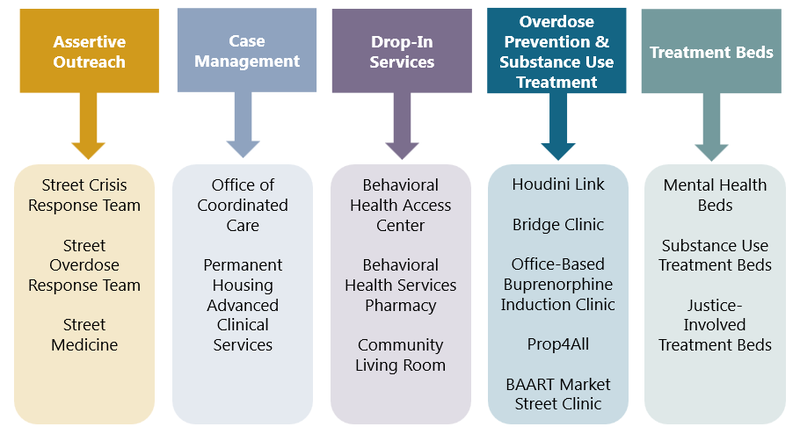
Assertive Outreach Services
Programs designed to support individuals experiencing homelessness with acute behavioral health needs, including mental health and substance use crises.
- Street Crisis Response Team (SCRT) provides rapid, trauma-informed response to people experiencing a behavioral health crisis to reduce law enforcement encounters and unnecessary emergency room use. As of June 2025, SORT and SCRT were consolidated into a single street crisis team operated by the San Francisco Fire Department.
- Street Overdose Response Team (SORT) responds to people immediately after an overdose, and again within 72 hours, to connect people to care and treatment. Support may include naloxone to reverse overdoses, medication for opioid use disorder, supportive counseling, and guidance getting substance use treatment, housing, or shelter. As of June 2025, SORT and SCRT were consolidated into a single street crisis team operated by the San Francisco Fire Department.
- DPH Street Health teams provide street-based mental health, substance use, and medical services for unsheltered people experiencing homelessness. The teams take a focused, neighborhood-based approach to ensure that shared-priority individuals with the most acute behavioral health challenges or chronic homelessness get on a path towards stability.
Case Management
Among behavioral health programs, case management includes supportive services provided by a social worker or peer counselor who assesses the client’s needs and arranges, coordinates, and advocates for various services to meet those needs. The OCOH Fund supports case management and transition support services to provide equitable and low-barrier access to behavioral healthcare and seamless transitions between systems and levels of care.
- Office of Coordinated Care (OCC): The Office of Coordinated Care offers case management services for priority populations needing engagement and connections to behavioral health care. The OCOH Fund supports the centralized assessment of clients referred from system partners, including hospitals, crisis services, the City’s street response system, and jail health services.
- Permanent Housing Advanced Clinical Services (PHACS): Permanent Housing Advanced Clinical Services provides healthcare services to residents of permanent supportive housing. PHACS provides non-urgent care, consultation, coaching, training, and care coordination. Clinicians also offer medication adherence support and direct nursing and medical care. PHACS serves people who were previously chronically homeless; many of these residents have complex medical and psychiatric needs. The program receives OCOH Fund support through both the Mental Health and Homelessness Prevention categories, and this report includes PHACS budget and expenditure within each service area’s page according to how funding was allocated. However, this report presents all client and program data solely within the Mental Health service area page.
Drop-In Services
Behavioral health services are available without an appointment on a walk-in basis. OCOH funds the Community Living Room walk-in center as well as expanded hours at the Behavioral Health Access Center and Behavioral Health Services Pharmacy.
- Behavioral Health Access Center (BHAC): A drop-in center and central access point located in SoMa that helps people learn about and connect to different types of mental health and substance use services. OCOH funds expanded hours that offer access to clients during evening and weekend hours.
- Behavioral Health Services Pharmacy: A pharmacy located in SoMa that fills prescriptions for people receiving mental health and substance use treatment through Behavioral Health Services. OCOH funds expanded hours that offer access to clients during evening and weekend hours.
- Community Living Room: This program offers a casual environment in which guests experiencing housing instability can access meals and connect to other services such as case management and HIV prevention and care. This program collects data on the number of guest check-ins, which are reported as Engagements, separately from Households Served data.
Overdose Prevention and Substance Use Treatment
The expansion of Overdose Prevention services is guided by the City’s 2022 Overdose Prevention Plan to increase the availability and accessibility of the continuum of substance use services for clients at risk of overdose. Programs receiving support from the OCOH Fund include:
- Clinics providing medication treatment for opioid use disorder integrated with community-based primary care and mental health care.
- Treatment programs offering drop-in counseling sessions and contingency management programs to reduce substance use.
- An addiction clinic led by addiction medicine specialists.
Treatment Beds
Treatment programs offer residential slots (“beds”) accommodating patients receiving behavioral health care. The OCOH Fund supports several types of residential care and treatment beds, which are defined as follows:
- Mental Health Treatment Programs
- Locked Sub-Acute Treatment beds serve individuals who need around-the-clock, close supervision and support by behavioral health staff to ensure the individual takes prescribed medication and receives support services.
- Psychiatric Skilled Nursing Facility beds provide 24-hour inpatient care in a licensed health facility or hospital and include physician, skilled nursing, dietary, and pharmaceutical services, and an activity program.
- Residential Care Facility (also known as Board and Care) beds provide a supervised residential program for individuals with mental health issues who require assistance with daily living activities, including meal preparation, medication monitoring, or personal care, but do not need daily acute medical care.
- Cooperative Living for Mental Health programs provide small-site housing (e.g., an apartment or shared home) paired with mental health treatment services.
- Crisis Stabilization Unit provides immediate, 24/7 voluntary medical care for people with urgent mental health needs who do not need a hospital or emergency department. The primary goal of these services is to rapidly reduce psychological distress, stabilize symptoms and refer individuals to appropriate treatment.
- Substance Use Treatment Programs
- Drug Sobering Center (SoMa Rise) is a 24/7 program for people experiencing homelessness with drug intoxication, providing short-term stays and linkage to services.
- Residential Step-Down programs (also known as “recovery housing”) provide a sober living environment for clients coming out of residential treatment programs.
- Managed Alcohol Programs provide medically supervised care for people with chronic alcohol dependency.
- Rapid Engagement Shelter and Treatment for Opioid Recovery (RESTORE) provides stabilization care using a shelter model for people who are starting medication treatment for opioid use disorder.
- Justice-Involved Treatment Programs
- Justice-Involved Transitional Dual Diagnosis (Minna Project) are treatment beds that provide transitional care for people in contact with the criminal justice system with a dual diagnosis of mental health and/or substance use issues.
- HER (Healthy Evolving Radiant) House Expansion is a women’s gender responsive alternative sentencing, transitional housing program for justice involved women and children.
Homelessness Prevention Programs
Homelessness Prevention is an Our City, Our Home (OCOH) Fund service area that supports programs designed to prevent homelessness. The OCOH Fund designates that up to 15% of the Fund may be appropriated for homelessness prevention services.
Homelessness Prevention programs are designed to help households at risk of homelessness secure or retain housing and can provide legal services, financial assistance, and other support services to those at risk of eviction.
Eviction Prevention and Housing Stabilization
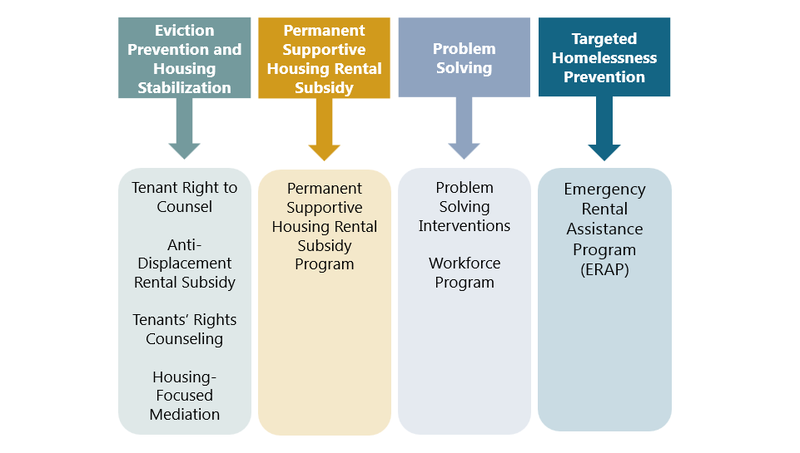
Programs in the Eviction Prevention and Housing Stabilization category provide wraparound and integrated services that keep vulnerable tenants housed and make otherwise precarious housing options sustainable for very low-income households. These services offer legal services, emergency rental assistance and support services through the following programs:
- Tenant Right to Counsel: Eligible tenants can receive support through the City’s legal defense system. City Attorneys are available to help tenants throughout the legal process of maintaining or acquiring housing. Social workers are also available to provide additional support.
- Tenants’ Rights Counseling: Eligible tenants can receive counseling and advocacy services regarding rent increases, habitability, reasonable accommodations, and other tenant-landlord matters. The program also offers Know-Your-Rights trainings and outreach for other prevention interventions.
- Housing-Focused Mediation: This program focuses on serving tenants in subsidized housing and providing technical assistance to their supportive housing providers such as de-escalation and collaborative property management approaches.
- Anti-Displacement Shallow Rental Subsidy: This program is targeted at extremely low-income households in rent-controlled units who pay at least 70% of their income toward rent.
Permanent Supportive Housing Rental Subsidy
Additional funding provided to support existing tenants in site-based permanent supportive housing to lower their rent.
Problem Solving
A creative, strength-based conversation that helps people explore all safe housing options available to them and identify possible resolutions to their housing crisis without waiting for shelter or housing from the Homelessness Response System. Problem Solving solutions can include, but are not limited to, mediation with family, friends, landlords, or others, family reunification, relocation assistance, or limited financial assistance to help preserve or secure housing.
- Workforce Program: Also within the Problem Solving category, OEWD provides workforce service strategies for people with lived experiences of homelessness who express interest in increasing their income through education or employment.
Targeted Homelessness Prevention Services
Flexible financial assistance to maintain housing or quickly return to housing for low-income SF residents at highest risk of homelessness. A cornerstone of this program is the San Francisco Emergency Rental Assistance Program (SF ERAP), which provides direct financial assistance to support very low-income households to remain in housing.
Shelter and Hygiene Programs
Up to 10% of the Our City, Our Home (OCOH) Fund may be appropriated for shelter and hygiene services. Shelter programs give people experiencing homelessness a temporary place to stay while accessing support services and looking for housing.
Case Management Services for Justice-Involved Adults
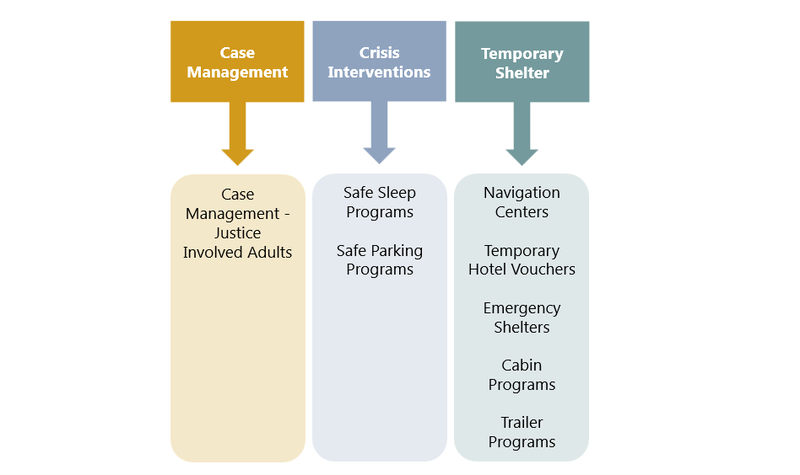
Support services and case management at a navigation center for adults who have interacted with the criminal justice system as defendants.
Crisis Intervention
Temporary outdoor safe places to sleep for people experiencing literal homelessness or fleeing domestic violence. These places do not meet the requirements of shelter according to HUD or City of San Francisco building standards. Crisis interventions may include Safe Sleep and Safe Parking programs. The City implemented Safe Sleep as part of the COVID-19 response and demobilized these programs in FY23.
- Safe Parking: Also called Vehicle Triage Center, a crisis intervention program that allows people living in their vehicles to park overnight, with security and some amenities, and connections to services.
- Safe Sleep: A crisis intervention program that allows people experiencing unsheltered homelessness to sleep safely outdoors, often in tents the participants provide themselves. Safe sleep sites are off sidewalks, with access to services and sanitation.
Temporary Shelter
Temporary, indoor safe places to sleep for people experiencing literal homelessness or fleeing domestic violence. Shelter programs provide four walls and a roof, access to plumbing, appropriate ventilation, adequate heating/cooling, electricity, and prepared food and/or cooking elements. Temporary shelter is an umbrella term for types of programs approved by the Department of Housing and Urban Development to operate as shelter. OCOH Fund temporary shelter programs include navigation centers, cabin program, trailer program, emergency shelters, and temporary hotel vouchers.
- Cabin Programs: Cabin programs offer individual cabin units with communal restrooms, showers, and other amenities and services.
- Emergency Shelters: Emergency shelters are facilities with amenities and services like showers, food, laundry, security, and case management. Programs may offer either congregate or non-congregate sleeping arrangements.
- Navigation Centers: Navigation Centers provide congregate sleeping while case managers work to connect unsheltered households to additional services including income, public benefits, health services, and shelter. Navigation Centers have few barriers to entry and accept people with partners, pets, and possessions.
- Temporary Hotel Vouchers: Also referred to as Urgent Accommodation Vouchers (UAV) programs, temporary hotel vouchers provide temporary hotel, or motel stays for people experiencing homelessness.
- Trailer Program: The City first established this program as part of the COVID-19 response and officially demobilized in February 2024. The Trailer Program provided guests with a trailer that included a kitchen, bathroom, electricity, and a small onsite medical clinic.
Additional Resources
Learn more about the OCOH Fund:
Review each OCOH Fund Annual Report for more details about the uses and impact of the OCOH Fund: