press release
American Indian Cultural District Unveils New Public Art Activations Centering Native Resilience, Cultural Knowledge, and Healing
Office of Economic and Workforce DevelopmentFour Native artists will transform public spaces across San Francisco through temporary sculptural installations rooted in storytelling, ecological knowledge, cultural continuity, and community healing.
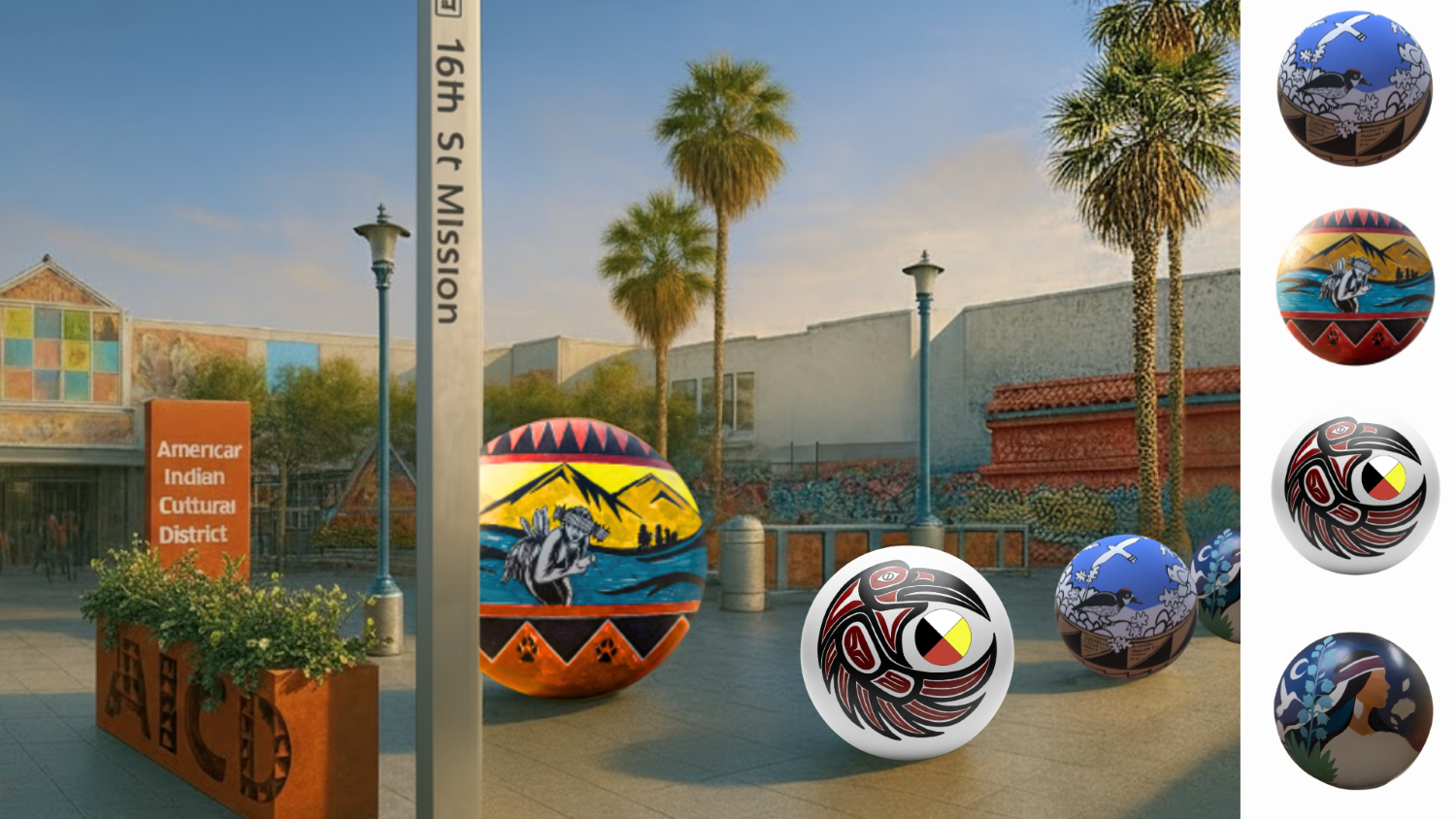
San Francisco, June 17, 2026 – The American Indian Cultural District (AICD) is excited to announce its newest public art project, featuring four large-scale sphere-shaped sculptural activations created in partnership with Mayor Daniel Lurie, the Office of Economic and Workforce Development (OEWD) and local Bay Area Native American artists. The installations reframe 250-year commemorations of San Francisco, California, and the United States by uplifting stories of Native resilience, cultural revitalization, and healing in response to the impacts of colonization and displacement.
Two three-foot sculptural spheres will be unveiled during the Mission Lotería activation, SÁBADO GIGANTE (Big Saturday), at the 16th Street BART Plaza on June 20, 2026, in the heart of the American Indian Cultural District. These spheres will be on view during BART Plaza activations to serve as a pilot for showcasing permanent large-scale art at the 16th Street BART Plaza. Outside of SÁBADO GIGANTE, the spheres will be displayed at local restaurants and organizations in the Cultural District as part of the AICD Uplift Local Campaign. Two additional five-foot spheres will be presented on July 4th as part of the Futures of Us, an event dedicated to civic imagination, fostering shared purpose, and empowering communities to shape the future of San Francisco.
“Arts and culture are driving San Francisco's recovery, and we want every community in our city to be part of it,” said Mayor Lurie. "These new installations will tell the story of our city's history and Native American history, and I'm excited to see how they will bring new life to 16th Street plaza.”
“These installations serve as an invitation to imagine a future where Native American stories, art, and cultures are permanent and visible in San Francisco’s public spaces,” said Sharaya Souza, Executive Director, American Indian Cultural District. “As a City and State-recognized Cultural District, our goal is to increase Native visibility and build momentum for permanent public art and cultural activations that honor and uplift American Indian cultures, histories, and contributions in Yelamu.”
This series of sculptures highlights Traditional Ecological Knowledge, cultural practices, Indigenous resilience, and healing, brought to life by Native artists:
· Raven by Maize Black (Mohawk) represents Healing
· Oak Family by Edward “Redbird” Willie (Pomo, Wintu, Paiute, and Wailaki) represents Traditional Ecological Knowledge
· The People’s District by Drew Valencia (Ohlone and Kashia Pomo) represents Cultural Practices and Dances of the Four Directions
· Seeds by Felicia Gabaldon (Choctaw) represents American Indian Resilience
“In Haudenosaunee (Iroquois) history, the Raven represents the bringer of life and is the direct speaker for the Creator. The very first Raven was sent by the Creator. The bird came to us with the very first seed to corn, so that humanity would exist. The Raven symbolizes resilience, protection, and perseverance across Turtle Island. The art work is a mixture of the Haida, Tlingit, and Haudenosaunee peoples, honoring the strength of Indigenous peoples and the responsibility to protect culture, community, and the land,” said Maize Black, Mohawk.
“Oak Family represents the relationships between the coastal live oak and the community it sustains. Centered around a traditional basket of acorns, the design honors Traditional Ecological Knowledge and the generations of bites, insects, and Native people who have relied on the oak as a source for nourishment, connection, and resilience. The oak is more than a tree; it is a relative, a provider, and a gathering space,” said Redbird Willie, Pomo, Wintu, Paiute, and Wailaki.
“Seeds is about the teachings, stories, and cultural knowledge we carry forward through generations. Just as seeds hold the potential for future growth, our communities continue to survive and flourish through care, renewal, and connection,” said Felicia Gabaldon, Choctaw.
These public art activations were developed through the broader Indigenize SF Initiative, a citywide placemaking and placekeeping effort dedicated to uplifting American Indian cultures, histories, and contributions through public art, cultural heritage, and educational experiences. The projects also advance the goals of the AICD Uplift Local Campaign, a neighborhood-based economic development initiative that leverages arts and culture, workforce development, tourism, and shop-local strategies to strengthen community identity and create tangible economic opportunities within and around the American Indian Cultural District.
“The purpose of us advocating for an American Indian District was to engrave our presence in a place where not only Native people will feel they belong, but to remind the city that American Indians have a relationship to this land, going back thousands of years, and we are still here. Our people and our culture is not to be forgotten,” said April McGill, Executive Director, American Indian Cultural Center.
Together, these temporary installations expand the growing network of Indigenous public art throughout San Francisco, creating spaces for storytelling, cultural visibility, and community healing while affirming the enduring presence of Native peoples in Yelamu (San Francisco).
“Song, dance, prayer, and history are the foundation of our people and are crucial for cultural continuance. Through public art, we create visible reminders that our cultures are still here, still thriving, and belong in the spaces we move through every day,” said Drew Valencia, Ohlone and Kashia Pomo.
All programming connected to the sphere installations will be free and publicly accessible, ensuring broad community participation, cultural affirmation, and opportunities for engagement with contemporary Native presence in San Francisco.
“We’re proud to support this meaningful art installation alongside the regular activations at the BART Plaza. Beautiful artwork like this helps us improve conditions in the plaza and create a space that truly belongs to the community, not only where people feel safe, but where they can be seen and find joy and connection,” said Anne Taupier, Executive Director, Office of Economic and Workforce Development.
The spheres were fabricated in Los Angeles by Tikal Composite Design.
This activation was made possible through the generous support and collaboration of partner organizations and merchants. Appreciation is extended to the organizations hosting the spheres and supporting the event: American Indian Cultural Center, Bay Area American Indian Two Spirits, Friendship House, La Raza Community Resource Center, La Raza Centro Legal, Reading Partners, Mission Housing Development Corporation, Centro del Pueblo, Youth Art Exchange, Abanico’s Coffee Roasters, and Prubechu.
About the American Indian Cultural District
Founded on March 31, 2020, the American Indian Cultural District (AICD) was officially recognized as a state-designated Cultural District by the California Arts Council (CAC) on Friday, December 12th, 2025. The AICD is the only recognized American Indian Cultural District of its kind in California, and the United States, dedicated to recognizing, honoring, and celebrating the American Indian legacy, culture, people, and contributions throughout Yelamu (San Francisco).
Located in the Mission District, the Cultural District serves as a home base for the local intertribal American Indian community and is rooted in the ancestral homeland of the Ramaytush Ohlone peoples. The District encompasses significant historical sites, Native-led organizations, cultural resources, education programs, and gathering spaces that have shaped Native life in the Bay Area for generations. Native-led organizations include the Bay Area American Two Spirits American Indian Historical Society, the International Indian Treaty Council, and the American Indian Cultural Center.
The District builds upon a long legacy of Native activism, cultural leadership, and community organizing, including the Occupation of Alcatraz (1969), The Longest Walk (1978), and key originating programs like the longest running Native radio show, KPOO Radio’s “Voices of the Native Nations” (1968), the landmark Indian Education Program, Title VI (1971), and the world’s first and longest-running American Indian Film Festival (1975).
Through placemaking, placekeeping, advocacy, cultural programming, and public art, the AICD works to ensure that Native communities remain visible, thriving, and celebrated for generations to come.
For more information on AICD and its work, visit: https://americanindianculturaldistrict.org/events and https://www.sfheritage.org/american-indian-cultural-district/