press release
Next Chapter for Renovated Mission Branch Library Begins After Grand Reopening and Unveiling of New Public Artwork by Juana Alicia and Reinstallation of Triptych Collection by Emmanuel Catarino Montoya
Arts CommissionIlluminated fused-glass artwork celebrates the Mission District's cultural heritage, resilience and Indigenous roots and restored triptych works honors the public library and community space as a place of shared knowledge and cultural exchange.
SAN FRANCISCO – The San Francisco Arts Commission (SFAC), in partnership with the San Francisco Public Library (SFPL) and Public Works (PW), today joined City officials and community leaders to celebrate the reopening of the historic Mission Branch Library following a major renovation project and the unveiling of five works in total by celebrated Bay Area artists Juana Alicia and Emmanuel Catarino Montoya in the library’s Main Reading Room, Teen Room, and Community Room.
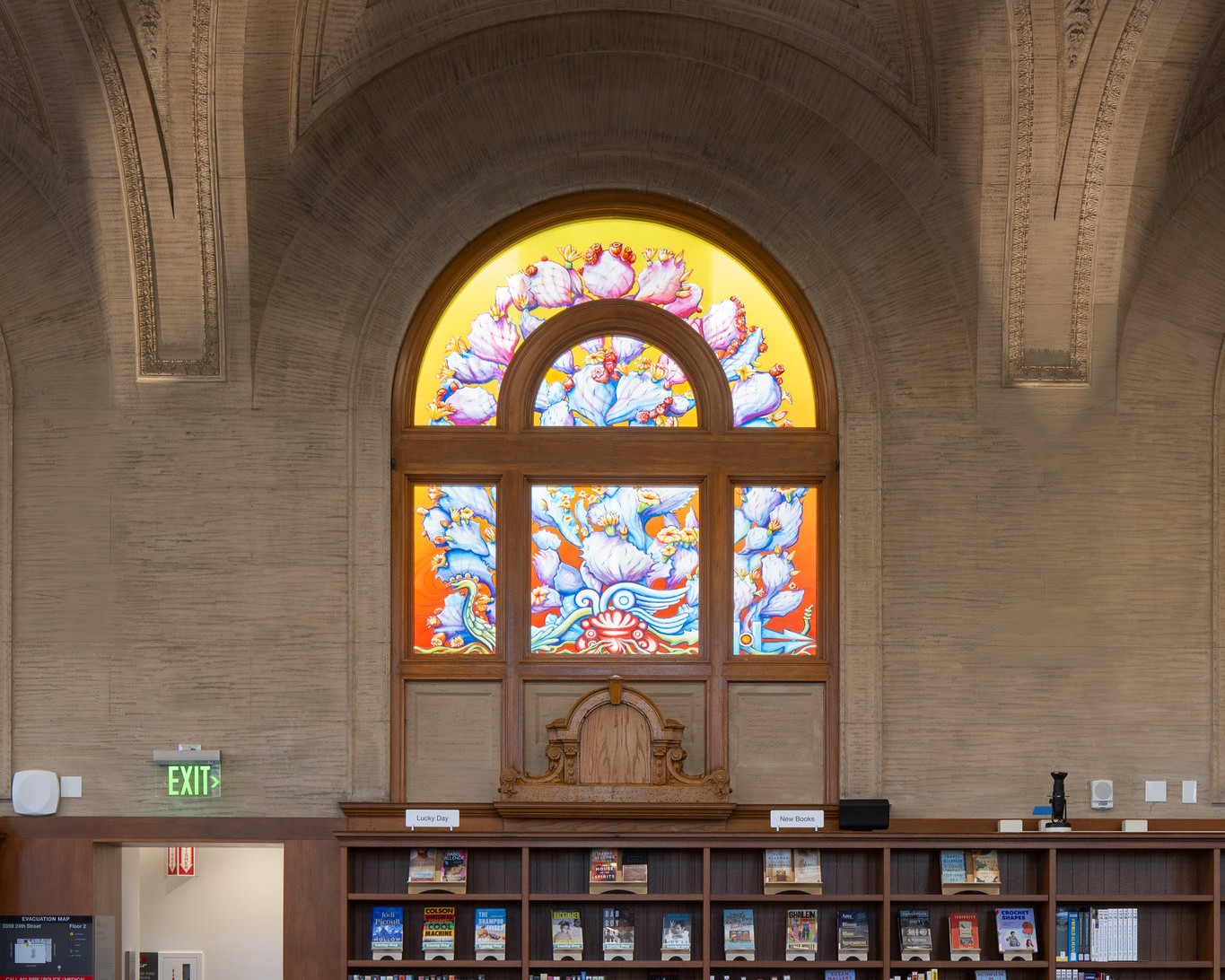
The Arts Commission oversaw a public review process that resulted in the selection of a site-specific artwork by Juana Alicia, titled NOPAL DE LA MISIÓN, which is comprised of two individual pieces: a fused-glass window installation in the historic Main Reading Room and a framed watercolor painting found in the new Teen Room of the library.
Funding for the public art program for the Mission Branch Library Renovation project was made possible by the City’s art enrichment ordinance, which allocates 2% of construction costs of above ground civic projects for public art.
Juana Alicia’s NOPAL DE LA MISIÓN depicts a monumental nopal (prickly pear) cactus whose violet pads and yellow flowers with red, star-shaped centers bring the vitality of the natural world into this creative, community-oriented space of study and reflection. The nopal is a symbol of resilience and sustenance—a plant that thrives in arid landscapes, regenerates easily, and nourishes both body and culture. For those of Mesoamerican heritage, it carries profound significance, rooted as it is in the history of the Nahuatl people, also known as Aztecs. In Nahuatl mythology, the nopal was the prophetic symbol indicating the founding of the sacred city of Tenochtitlan (Mexico City), tied to the goddess Malinalxochitl, whose name combines the Nahuatl words malinalli (grass) and xochitl (flower). The artwork also depicts the Quetzalcoatl, the feathered serpent and deity of culture and wisdom.
Juana Alicia collaborated with Jackman Glassworks and Magnolia Editions on the fabrication of the five-panel artwork, which is comprised of fused glass layers adhered to tempered carrier glass. The cutout shapes are layered with colored glass pigments, as seen, for example, in the fruit or tunas of the nopal. These assembled pieces are baked in a kiln to produce highly saturated, refractive and textured surfaces. The tempered carrier glass bolsters the vibrant composition with a UV acrylic print of the image. The artwork is backlit with an LED light panel system that was customized by San Francisco Public Works for the library’s site-specific architecture. The glass art panels were skillfully installed by PW’s contractor, SJ Amoroso and subcontractor US Glass.
“The fused glass window, NOPAL DE LA MISIÓN, is a love letter to this community that saw me come of age, blossom, and mature into the artist I am today. Since the first mural I created in the Mission, Las Lechugueras, until today, I have been part of a phenomenal cultural movement,” said artist Juana Alicia. “This work pays homage to the Opuntia Violacea variety of the nopal, a beautiful violet, and brings the vibrant life of the natural world into the library environment, offering its yellow flowers with red, star-shaped centers to the Reading Room's creative, intellectual, and community-oriented space.”
Art Enrichment funds also allowed for the conservation and re-installation of an existing triptych artwork by artist Emmanuel Catarino Montoya titled Quetzalcoatl: Pre-Colombian Deity of Knowledge and Culture, Egypt’s Contribution to European Civilization, and Wen Ch'ang: Chinese Deity of Literature, commissioned in 1999 and was previously on view at Mission Branch and has been re-sited in the library’s new Community Room.
A “triptych" is a work of art, writing, or music composed of three distinct sections or panels designed to be displayed or considered together as a single, cohesive unit.
Montoya’s triptych brings together three cultural representations of learning—Quetzalcoatl, Wen Ch’ang, and Egypt’s contribution to European civilization—to celebrate libraries as places where knowledge is saved, shared, and renewed. For many people in San Francisco’s Mission District, daily life looks like this artwork: different languages, cultures, and histories living side by side. Montoya’s message is simple: Communities grow stronger when we learn from more than one tradition.
Montoya created this body of work over seven years using reduction-relief linocut printmaking, a technique where the artist progressively carves, inks, and prints layers of colors from a single linoleum block. Each round of carving removes more material, so earlier layers can’t be reprinted. By the time the final piece is completed, the block is ultimately destroyed—one reason these prints are made in limited editions. The process requires inverse visualization of imagery, exact alignment for precise color registration, and patience for drying times between layers. In the Quetzalcoatl print, Montoya used more than thirty colors, adding monoprint textures, hand-applied inks, and colored pencils to build richness and depth.
“Public art helps tell the stories of our neighborhoods and ensures that the communities who shape San Francisco see themselves reflected in our civic spaces,” said Matthew Goudeau, Executive Director of Arts and Culture. “Juana Alicia’s NOPAL DE LA MISIÓN celebrates the rich cultural history and creative spirit of the Mission District. We are proud to partner with the San Francisco Public Library to bring this new work to life alongside Emmanuel Montoya’s triptych from the Civic Art Collection, connecting the neighborhood’s artistic legacy with its future.”
Mission Branch has been a cornerstone of the Mission neighborhood for more than 130 years. As the first branch in the SFPL system, the original branch opened in 1888 in a storefront two blocks from its present location. The current building at 24th and Bartlett opened in December 1915, funded by donations from philanthropist Andrew Carnegie and built under the supervision of Beaux Arts architect G. Albert Lansburgh in the Italian Renaissance Revival style. The building was renovated in 1997 to make seismic improvements and accessibility upgrades but led to the loss of some of the building’s most recognizable characteristics, including the original 24th Street entrance and the grand central staircase. The building received landmark status from the City in 2002.
“We are thrilled that our mission-driven staff is returning to the majestic Mission Branch Library,” said Michael Lambert, City Librarian. “We couldn’t be more delighted with the restoration and enhancement of this historic neighborhood library. This once-in-a-generation investment will secure the future of this vital community hub for the next century of service, and it’s now yours to enjoy.”
About the Artists
Juana Alicia was born in 1953 in Newark, NJ and has been based in the Bay Area since 1973. Alicia is a muralist, printmaker, sculptor, illustrator, and studio painter well-known for work that addresses issues of social justice, gender equality, and the environmental crisis. She is a key figure in the Chicano Art movement and her murals can be seen across the globe, and in the Bay Area at notable sites such as The Women’s Building, Stanford University, San Francisco State University, University of California in Santa Cruz, and numerous other locations. Her highly political work has deep ties to activism and comments on the injustices we grapple with, particularly through the intersectional lenses of decolonization, feminism, and Mexican and Indigenous identity, as well as hope for a more equitable and just world. Juana Alicia spends time between Berkeley and Mérida, Yucatán.
NOPAL DE LA MISIÓN, 2026 is the artist’s second permanent public art commission for SFAC. In 2000, Juana Alicia and Emmanuel Catarino Montoy created Santuario/Sanctuary, a permanent fresco mural and basswood bas-relief sculpture for SFO’s International Terminal. In 2023, SFAC Galleries presented the solo exhibition, Me Llaman Calle: The Monumental Art of Juana Alicia.
Emmanuel Catarino Montoya is a multidisciplinary artist, printmaker, and enrolled member of the Lipan Apache Band of Texas. Born in 1952 in Corpus Christi, Texas, he is of Indigenous and Mexican heritage and has spent more than sixty years living and creating in the San Francisco Bay Area. After attending public schools in San Francisco, Emmanuel earned an Associate of Arts degree from City College of San Francisco and went on to earn a Master of Fine Arts in Printmaking at San Francisco State University.
Emmanuel's artwork reflects a lifetime of cultural, artistic, and political influences. His visual language draws from the Chicano Movement of the 1960s and 1970s, the traditions of Mexican and Latin American printmakers and muralists, and the socially conscious art movements that emerged across North America during the 1930s and 1940s. As a young artist growing up in San Francisco, he was especially inspired by the vibrant imagery and expressive typography of Bill Graham's legendary rock concert posters. Their bold colors, movement, and energy continue to surface throughout his work today.
At the heart of Emmanuel's practice is a deep commitment to relief printmaking. He is drawn to the medium's tactile process, visual power, and rich history, connecting him to generations of printmakers throughout Mexico, Latin America, and the United States. Through his work, Emmanuel explores identity, culture, history, and resilience, creating art that honors Indigenous and Mexican experiences while fostering connection, reflection, and community.
###
About the San Francisco Arts Commission
The San Francisco Arts Commission is the City agency that champions the arts as essential to daily life by investing in a vibrant arts community, enlivening the urban environment and shaping innovative cultural policy. Our programs include: Civic Art Collection, Civic Design Review, Community Investments, Film SF, Grants for the Arts, Public Art, SFAC Galleries, and Art Vendor Licensing. To learn more, visit sf.gov/artscommission