Info Page
SF Health and Human Services Good Neighbor Policy
San Francisco's ability to open and sustain the housing, health, and social-service sites our residents depend on rests on a foundation of community trust. This policy exists to protect that trust through a single, clear, citywide standard for how health and human services providers and the City together steward the public space around covered sites.
Introduction
The policy reflects extensive feedback from service providers, community organizations, residents, businesses, clients, neighbors, and City partners. That input helped make the policy clearer, safer, and more workable while maintaining our shared expectation that City-funded sites contribute to safe, clean, and welcoming communities.
The policy creates an opportunity to strengthen relationships between social service agencies and their residential and business neighbors. It also provides clearer expectations for providers and a more consistent framework for City departments to respond when concerns require additional support.
Under the policy:
- Sites will proactively monitor the area immediately surrounding their facilities during operating hours.
- Providers will address concerns involving their clients or guests when it is safe and appropriate to do so.
- When an issue requires Public Works, Police, Fire, Emergency Management, or another City agency, providers will raise the concern and document the escalation through the appropriate City system.
- Staff will not be expected to engage when doing so could create a safety risk. Taking action once it is safe is consistent with the policy.
- Complaints will be reviewed based on the available facts and the actions taken—not simply the number of complaints a site receives.
- When corrective action is necessary, the responsible City department will be more directly involved through contract management tools, implementation support, and participation in community meetings when appropriate.
The City is also developing a single integrated digital tool to replace multiple logs and reporting processes.
The goal is to reduce duplicative paperwork, improve consistency, and give frontline staff greater clarity about Good Neighbor expectations without creating significant new administrative burdens.
Citywide Good Neighbor Policy
The City's Health and Human Services Good Neighbor Policy (GNP) is built on a simple premise: clean and safe streets are a shared responsibility.
We ask our providers to commit to consistent site stewardship, partnership with the city to address street conditions, and good-faith engagement with their neighbors. In turn, the City commits to responding to escalations, resourcing the work, and holding its own departments jointly accountable for good neighbor concerns.
Download a copy:
What It Means to Be a Good Neighbor
1. Manage Your Perimeter
- Conduct three perimeter checks a day.
- Manage queues and dispose of waste related to your site's services.
- Discourage excessive noise, sidewalk blockage, and disruptive behavior by clients or their guests.
2. Ask for Help
- Escalate any other issues to the City through the Good Neighbor app, which routes to 311 and non-emergency response.
- When a situation calls for 911, call 911.
3. Be Responsive to Community Concerns
- Acknowledge receipt of Good Neighbor concerns within 24 hours.
- Make a reasonable effort to resolve routine concerns within 72 hours.
- Engage your City program manager as a problem-solving partner on Good Neighbor concerns.
4. Train and Orient Your Team
- Complete annual staff training in de-escalation, trauma-informed engagement, and safety.
- Provide a Good Neighbor orientation for participants staying 30+ days.
What's Next
August 2026
- Revised policy announced and Good Neighbor app testing begins.
September – October 2026
- Good Neighbor app is scaled and formal provider training begins.
November – December 2026
- Implementation period, followed by enforcement window. Exact dates TBA.
Scope
- All Department of Homelessness and Supportive Housing (HSH)-funded sites, including:
- property management contracts for supportive housing;
- shelter and transitional housing operations contracts; and
- access points and drop-in center contracts
- All Department of Public Health (DPH) client-serving program contracts
- MOHCD (LOSP-funded) and HSA-funded sites under review for potential GNP adoption
Questions? Contact your HSH or DPH program manager.
Corrective Action Ladder: What Happens at Each Step
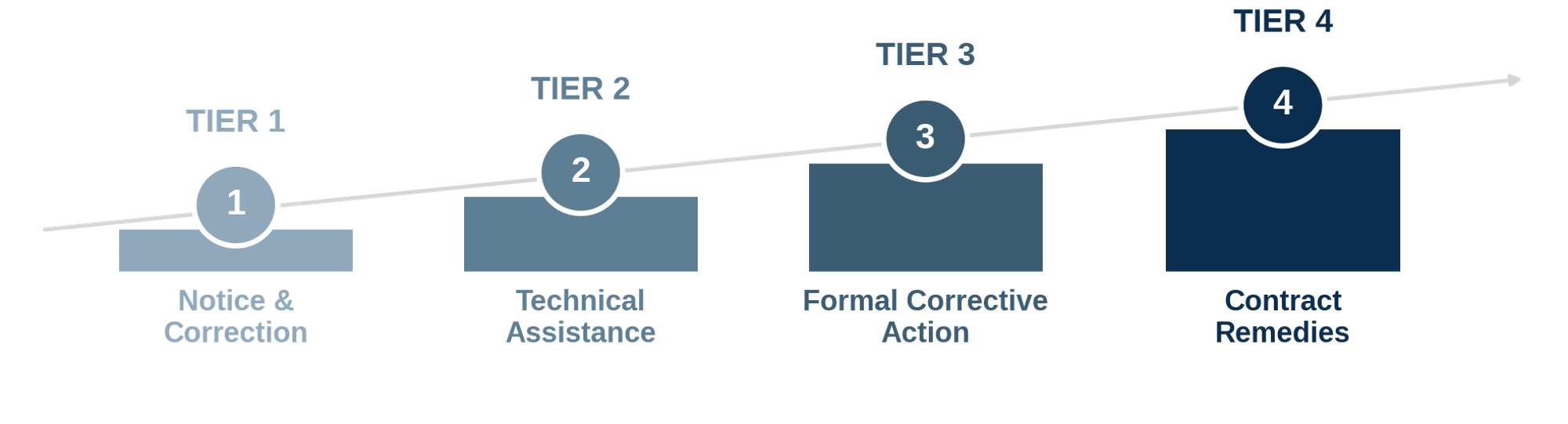
Tier 1: Notice & Correction
- Verbal or written notice of the concern
- Required corrective steps, with a timeline
- Perimeter checks/documentation may be added by written notice, if not already required
Tier 2: Technical Assistance
- Written notice of non-compliance
- Formal technical assistance from the department
- Follow-up monitoring and status reporting
- May require community meeting attendance
Tier 3: Formal Corrective Action
- Increased monitoring frequency
- Operational changes: staffing adjustments, revised perimeter-check protocols, management review
- May require hosting or attending community meetings
Tier 4: Contract Remedies
- Remedies consistent with contract terms
- May include restrictions on expansion, payment holds, scope modification, re-procurement, or termination
Frequently Asked Questions
1. Does this apply to my program?
A. Yes, if your site is an HSH-funded shelter, transitional housing, access point, drop-in center, or PSH property management contract; or a DPH client-serving program contract. Check with your program manager if you're unsure.
2. Do we really need to do three perimeter checks a day, every day?
A. Three checks a day is a best practice and is required for all city-contracted sites. Please refer to the Good Neighbor Policy to determine if documentation of the perimeter checks will be required for your site. If you are unsure, contact your program manager.
3. What exactly is the “GN app,” and do we need to buy or build anything?
A. The GN app is a single citywide tool for logging Good Neighbor concerns, actions, and escalations. It will be provided by the City at no cost. It's in testing now, with training rolling out this fall.
4. When will we need to start using the Good Neighbor application?
A. After the pilot phase of GN app testing, the City will scale access to all providers. You'll need to start using it once the City announces the formal implementation date — currently planned for November/December 2026. Enforcement will begin after a period of implementation, not on day one.
5. How will staff at my site access the Good Neighbor application?
A. It will be accessible through a computer or mobile device. If your site needs to procure a shared device to access it, the City will reimburse that cost.
6. Does the GN app require us to enter client names or health information?
A. No. The app does not require participant-identifying information or protected health/treatment information.
7. Are our staff expected to physically intervene if someone is being disruptive or threatening?
A. No. Staff are never expected to physically intervene, enforce the law, or take any action that isn't safe. The compliant response is to de-escalate when it's safe to do so, and to disengage and escalate — through the GN app, 911, or 311 — when it isn't.
8. What if the person causing a problem isn't one of our clients?
A. You're responsible for addressing concerns tied to your own clients and guests. Issues involving unaffiliated individuals with no connection to your program should be escalated to the appropriate City department, not managed by your staff.
9. Our site shares a building with another organization. Who's responsible for compliance?
A. One “primary operator” — generally the organization holding the direct contract or master lease — is the designated point of contact and accountable party for Good Neighbor compliance at that site. Co-located organizations will need to partner with the primary operator to implement GNP. Contact your program manager to discuss considerations related to co-located sites.
10. What happens the first time we fall short of a requirement?
A. The City starts at Tier 1: a verbal or written notice and a chance to correct the issue on a timeline, generally with technical assistance offered rather than a penalty. Escalation depends on severity, duration, and recurrence — not a single incident.
11. Will we lose funding or get shut down over a single complaint?
A. No. Compliance is judged on your documented actions in the context of your program's capacity — not on complaint volume alone, and not on one incident. Contract remedies (Tier 4) are reserved for sustained, unresolved noncompliance after earlier tiers have been tried.
12. Do we have to attend community meetings?
A. Only if your site is under Tier 2–4 corrective action and the department formally requests it. Virtual attendance is acceptable unless otherwise specified.
13. What training do we need, and when?
A. All relevant staff need training at onboarding and annually thereafter, covering de-escalation, trauma-informed engagement, and safety. Formal Good Neighbor training and the app rollout happen this fall (September-October 2026); watch for details from your program manager.
14. Who do we contact with questions, or to report something the app doesn't cover?
A. Your HSH or DPH program manager is your first point of contact for anything Good Neighbor-related that falls outside the app's routing to city departments.
15. What contact information do we need to post at our site, and what will the City provide?
A. Each provider must maintain a public phone number and email address for Good Neighbor concerns and post that information in a clearly visible location, such as a front window or door. Providers must also monitor these contacts during business hours and have a process for reviewing urgent concerns after hours. The City will reach out to collect this information form providers and provide a standard signage template and maintain a public webpage with Good Neighbor Policy information and relevant contact information. The webpage link will be included on the City's signage template for providers to post at each covered site.
16. How should a neighbor or community member document or report a Good Neighbor complaint or concern about a site?
A. Members of the public should contact the site directly using the public phone number or email address posted at the building. Providers are required to monitor these contacts, acknowledge Good Neighbor concerns within 24 hours or by the next business day, and make reasonable efforts to resolve routine concerns within 72 hours.
17. What should a Community-Based Organization (CBO) do if it has more than one city funding partner for an eligible site?
A. If your site is funded by multiple city departments, you don't need to coordinate separate monitoring processes on your own. The relevant city departments will work with you to align their monitoring activities for your site. This means your CBO won't be subject to duplicative or conflicting monitoring visits, reviews, or reporting requirements.