Published November 4, 2026
Table of contents
- Background
- Descovy (F/TAF) now an additional option for vaginal/front-hole protection
- PrEP regimen selection summary table
- Routine management of LAI PrEP
- Oral bridging for missed PrEP injections
- Guide to PEP for LAI PrEP patients
- Resources and more information
1. Background
The 2025 approval of lenacapavir for PrEP by the FDA, as well as the 2025 release of Updated PrEP Recommendations from the 2024 IAS-USA Panel, have prompted local discussion of several clinical topics related to PrEP.
San Francisco City Clinic convened a panel of 12 clinical providers and biomedical prevention experts to discuss gray areas and emerging issues in HIV PrEP. The panel reviewed the literature, including conference abstracts and presentations, and developed consensus recommendations to address gray areas, for example management of HIV testing or PEP in the setting of late PrEP injections.
This list of clinical updates provides the panel’s guidance on these topics for San Francisco clinicians.
Abbreviations used in this document
General terms
- CAB: cabotegravir, brand name Apretude
- LEN: lenacapavir, brand name Yeztugo
- LAI: long-acting injectable
- IM: intramuscular
- SC: subcutaneous
Medications
- F/TDF: emtricitabine and tenofovir disoproxil fumarate, brand name Truvada
- F/TAF: emtricitabine and tenofovir alafenamide, brand name Descovy
- FTC/TAF/BIC: emtricitabine, tenofovir alafenamide, and bictegravir; brand name Biktarvy
- DTG: dolutegravir, brand name Tivicay
- TDF: tenofovir disoproxil fumarate
- TAF: tenofovir alafenamide
- FTC: emtricitabine
- 3TC: lamivudine
- INSTI: integrase strand transfer inhibitor
2. Descovy (F/TAF) now an additional option for vaginal/front-hole protection
This panel concurs with the IAS-USA Panel’s 2025 recommendation of F/TAF for vaginal/front-hole protection against HIV for those in whom F/TDF is contraindicated or undesirable, in light of a 2025 analysis of PURPOSE 1 data showing an 89% reduction in risk for HIV acquisition in cisgender women who had biomarker evidence of taking at least a mean of 2 doses per week of F/TAF, compared to those who had a mean of less than 2 doses per week.
For daily oral PrEP, F/TDF (Truvada) remains this panel’s first-line recommended daily oral regimen for sexual exposure.
- Use the second-line daily oral PrEP formulation, F/TAF (Descovy), if F/TDF is contraindicated, undesirable (due to side effects, or for any other patient-driven reason), or if the patient is uninsured and unable to afford generic F/TDF, in which case they can receive Descovy through the Gilead Advancing Access patient assistance program.
3. PrEP regimen selection summary table
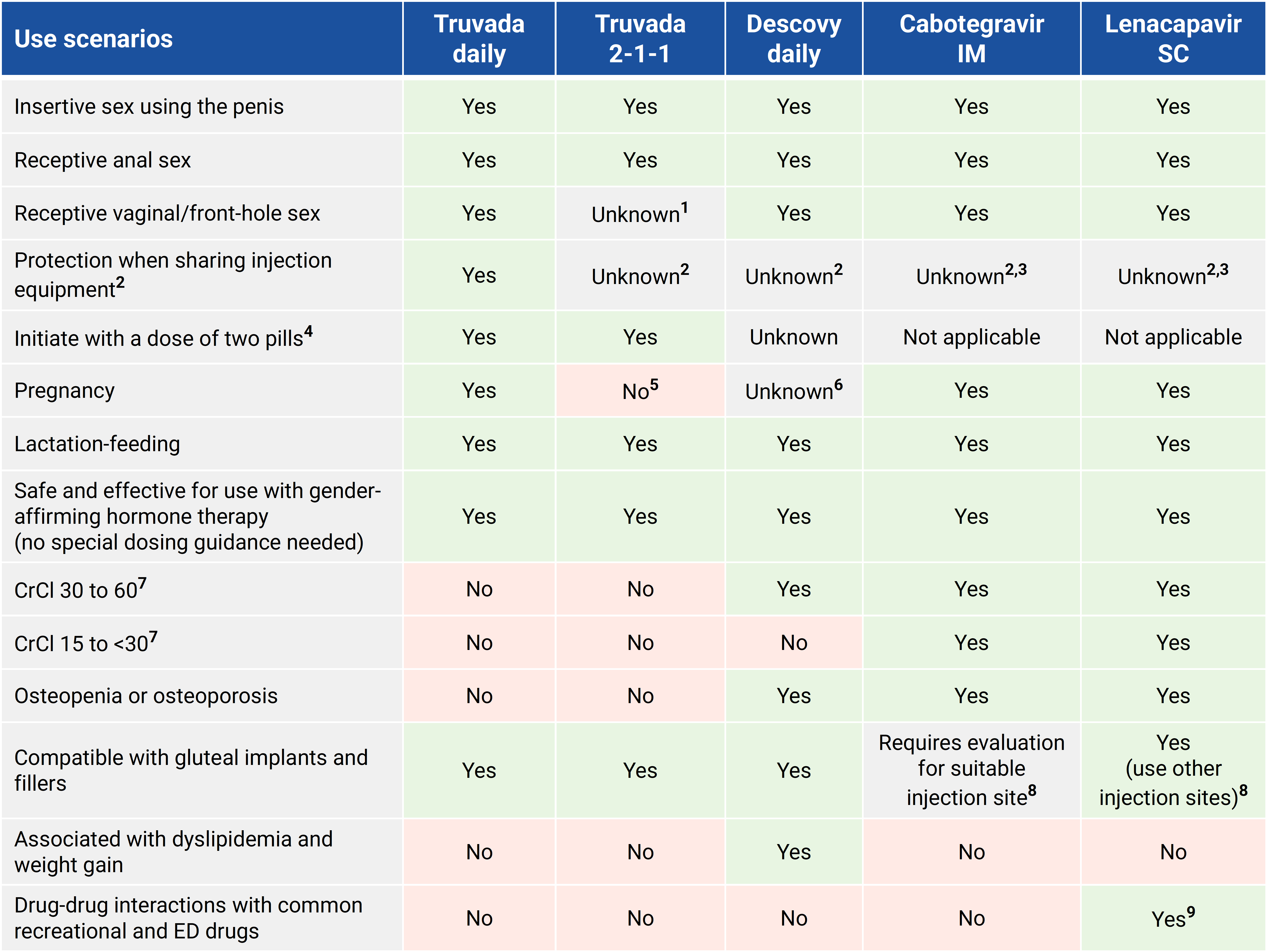
Table footnotes
- 2-1-1 dosing has not been studied for protection during receptive vaginal/front-hole sex. For patients having condomless receptive vaginal/front-hole sex whose only acceptable or feasible PrEP regimen is 2-1-1 PrEP, it may be reasonable to prescribe 2-1-1 PrEP via shared decision-making with clear counseling that effectiveness data are unavailable. Adding one additional dose (2-1-1-1) may help better achieve protective medication levels for vaginal/front-hole protection.
- People who inject drugs may need protection against HIV when having sex, so this panel recommends prescribing the regimen that best fits the patient’s dosing and HIV protection needs. In some cases, this may mean prescribing a regimen proven to protect during sex even if not proven to protect when sharing injection equipment.
- CAB and LEN are currently being studied in people who inject drugs.
- The IAS-USA 2024 Panel recommends a dose of 2 pills of Truvada upon initiation of daily dosing for all, regardless of gender or body parts used for sex, to hasten onset of protection.
- Pregnancy lowers tenofovir levels which could compromise efficacy of 2-1-1 dosing. For this reason, 2-1-1 PrEP is not recommended during pregnancy, regardless of body parts used for sex.
- Stratified efficacy data in pregnancy are not available for Descovy, though PK data are encouraging. For pregnant patients whose only acceptable or feasible PrEP regimen is Descovy, it may be reasonable to prescribe Descovy via shared decision-making with clear counseling that effectiveness data are unavailable.
- CAB and LEN are preferred for patients with significant renal disease given their minimal renal clearance, lack of known nephrotoxicity, and no required dose adjustments for CrCl ≥15 mL/min.
- This clinical update provides more details on how to evaluate for suitable injection site in section “Injection site options (including considerations for patients with fillers or implants)”.
- This clinical update provides more details in section “Drug-drug interactions between LEN and certain common drugs”.
View the table in accessible format
4. Routine management of LAI PrEP
Find clinical updates on routine management of long-acting injectable (LAI) PrEP:
Time to protection and overlap of oral PrEP at initiation of LAI PrEP
Cabotegravir (CAB)
- Time to protection is not known with certainty. The available evidence suggests 50% of people will achieve protective blood levels 1 day after the first injection, 90% of people 3 days after the first injection, and 95% of people 7 days after the first injection.
- Many experts do not believe overlap of oral PrEP and injectable PrEP is needed. There was no overlap in the studies which showed very high efficacy.
- If your practice is not providing immediate same-day starts on CAB and instead must order CAB from a specialty pharmacy, offer patients an optional overlap of oral Truvada or Descovy while they wait to start CAB. Patients can stop taking Truvada or Descovy anytime between day 1 and day 7 of IM CAB, based on their desired duration of overlap, given the available evidence.
Lenacapavir (LEN)
- Data on time to protective levels are limited, but rapid increases have been observed in plasma concentrations of LEN after the initial oral loading dose and first injection, reaching therapeutic levels within hours after the second oral loading dose on day 2.
- If the second oral loading dose is missed, the time to protection increases to 21 days.
- If both oral loading doses are taken on schedule, many experts do not believe it is necessary to overlap those doses with additional oral PrEP medications. There was no overlap in the studies which showed very high efficacy.
- If your practice is not providing immediate same-day starts on LEN and instead must order LEN from a specialty pharmacy, offer patients an optional overlap of oral Truvada or Descovy while they wait to start LEN. Patients can stop taking Truvada or Descovy the day they receive their first LEN injection.
Routine HIV testing for CAB and LEN
The CDC has published guidance on HIV testing in the setting of injectable CAB and LEN PrEP. This panel provides additional guidance for San Francisco’s local setting:
At CAB or LEN initiation
- If patient is currently using another form of PrEP without interruption, draw a laboratory blood-based HIV Ag/Ab test (no HIV RNA test needed). The provider and patient may choose to administer the first dose of LEN or CAB while laboratory blood-based HIV Ag/Ab result is pending.
- If patient is not currently using PrEP, draw laboratory blood-based HIV Ag/Ab and HIV RNA tests. Wait for the result of the HIV Ag/Ab result before administering the first dose of LEN or CAB. The HIV RNA test result can still be pending.
- Using a blood-based HIV rapid test for same-day LEN or CAB administration:
- The provider and patient may choose to administer the first dose of LEN or CAB while laboratory blood-based HIV Ag/Ab and HIV RNA results are pending by performing a blood-based HIV rapid test, provided there are no signs or symptoms of acute HIV.
- Same-day LEN or CAB administration without blood-based HIV rapid test:
- If no rapid test is available that day, the provider and patient may use shared decision-making to consider administering the first dose of LEN or CAB while laboratory blood-based HIV Ag/Ab and HIV RNA results are pending, provided there are no signs or symptoms of acute HIV. One factor to consider is provider and/or patient preference to avoid a gap in protection against HIV, which could happen if the patient must return a different day for the injection.
- Using a blood-based HIV rapid test for same-day LEN or CAB administration:
- As a safeguard, it is recommended to confirm that the patient has a reliable means of being contacted if the laboratory blood-based HIV Ag/Ab or HIV RNA result is positive.
At CAB or LEN continuation injections
- If injection is on time, order a laboratory blood-based HIV Ag/Ab test.
- If injection is late, order both laboratory blood-based HIV Ag/Ab and HIV RNA tests.
- A CAB injection is late if:
- It is a 2nd initiation injection and 5 or more weeks have passed since the first injection.
- It is a continuation injection visit and more than 10 weeks have passed since the last injection.
- A LEN injection is late if:
- More than 28 weeks have passed since the last injection and oral LEN bridging was not taken in the interim.
- A CAB injection is late if:
More frequent testing not recommended with LEN
HIV testing is not recommended more often than at each LEN continuation injection. However, the provider and patient can consider performing STI testing every 3 months, and can consider adding HIV testing when doing so.
Drug-drug interactions between LEN and certain common drugs
The patient’s current prescribed and over the counter medications, as well as supplements, herbals, and recreational substances should be reviewed and assessed for potential drug-drug interactions (DDIs). Interactions can be checked using the Liverpool HIV Drug Interactions Checker.
Counsel all LEN patients that DDIs can persist for up to 9 months after the last LEN injection.
DDI counseling needed
- Ketamine: Ketamine concentrations may increase due to inhibition of CYP3A4 by LEN and may increase side-effects associated with ketamine, such as respiratory depression and hallucinations. Patients who use ketamine should be counseled to use caution and that effects could last longer than usual. Patients may consider halving their usual ketamine dose.
- Erectile dysfunction drugs: Concentrations of PDE5 inhibitors (i.e sildenafil, tadalafil) may be increased.
- For sildenafil: Start at a dose of 25 mg.
- For tadalafil:
- For use as needed: no more than tadalafil 10 mg every 72 hours.
- For once daily use: not to exceed 2.5 mg daily.
DDI counseling not needed
- Fentanyl
- GHB
Injection site options (including considerations for patients with fillers or implants)
Injection site options for CAB
- CAB is approved for administration by intramuscular (IM) injection into the buttocks (gluteal muscle).
- The recommended site is the ventrogluteal site (side of the hip/buttock). The dorsogluteal site (upper, outer quadrant of the buttock) is also acceptable.
- Do not inject CAB into other sites, including the thigh, as data show that injection in the thigh yields lower medication levels, which may not be protective.
Injection site options for LEN
- LEN is approved for subcutaneous injection primarily in the abdomen or the thigh.
- Absorption of LEN, safety, and tolerability are also adequate when it is injected in the upper buttocks or back of the upper arm.
- Injection site reactions may be more common with administration in the abdomen compared with the other anatomic sites.
Patients with injectable fillers
- Injectable fillers can be difficult to differentiate from surrounding tissues via exam.
- For patients with injectable fillers in the gluteal area desiring injectable PrEP, offer LEN as a primary regimen, as other anatomical sites are available.
- If the patient prefers CAB instead, provider should consider imaging to differentiate areas with and without fillers present.
Patients with gluteal implants
For patients with implants in the gluteal area desiring injectable PrEP:
- Offer LEN with administration via the abdomen, upper thigh, or back of the upper arm.
- Alternatively, offer an exam to identify areas adjacent to the implant that are safe for CAB or LEN injection. If examination is inconclusive in identifying an area suitable for injection, recommend LEN via the abdomen or upper thigh. If gluteal injection site is still desired for any reason, consult a professional with experience in palpating gluteal implants, or consider imaging to identify the implant’s outline.
5. Oral bridging for missed PrEP injections
In the event of delayed or missed injections of CAB or LEN PrEP, prescribe oral PrEP medication to bridge the patient until the next injection.
The package inserts for CAB and LEN provide guidance for oral bridging medications. This panel provides additional guidance:
- Consider prescribing the oral PrEP medication at initiation and yearly rather than waiting until patient misses an injection. When prescribing the oral medication, counsel the patient to take it in the event of a missed or delayed PrEP injection.
- Counsel patient at initiation to contact you as soon as they know they are going to miss an injection.
Additional considerations:
- Prescribing the oral formulation of the same medication (i.e. oral CAB for IM CAB, oral LEN for SC LEN) is often preferred by patients and providers. This maintains the injectable medication’s drug levels between injections and can prevent needing to complete re-induction dosing when resuming LEN injections. However, if needed for any reason, providers can prescribe F/TDF or F/TAF instead.
- Do not prescribe a different injectable medication’s oral formulation (i.e. do not prescribe oral LEN to bridge IM CAB injections, or vice versa).
- The package insert for CAB and LEN provide guidance for using an oral formulation. If a patient needs oral PrEP longer than the label guidance allows for oral LEN or CAB, prescribe F/TDF or F/TAF.
6. Guide to PEP for LAI PrEP patients
Do not delay PrEP injections, even if the patient has had a possible exposure to HIV or is prescribed PEP, and even if they do not complete the course of PEP.
Proceeding with PrEP injections avoids gaps in protection from HIV. Read below for more detailed guidance.
When to consider PEP
Consider PEP when a patient has condomless anal or vaginal/front-hole sex in the past 72 hours and was not protected by PrEP at the time of sex.
A patient may need PEP at LAI PrEP initiation or at continuation injection visits. Examples of when a patient is not protected by PrEP:
- Has not yet started PrEP (injectable or oral)
- Was taking oral PrEP but stopped or did not take enough doses for effective protection
- Is late for a PrEP injection and did not take enough doses of oral bridging medication for effective protection
When does CAB protection end
At 2nd initiation injection visit
Conduct assessment for PEP if 5 or more weeks have passed since the first injection. This is when protection from CAB begins to wane.
At continuation injection visit
Conduct assessment for PEP if 10 or more weeks have passed since the last injection.
When 10 to 16 weeks have passed since the last injection, this panel recommends using shared decision-making to decide whether to initiate PEP, weighing factors such as time since last injection and estimated efficacy, risk of potential exposure, patient and provider risk tolerance, and patient factors such as willingness or ability to take pills.
- HIV Prevention Trials Network (HPTN) estimates of cabotegravir efficacy based on time since each dose are as follows:
- 1-8 weeks: 98%
- 9-10 weeks: 96%
- 11-12 weeks: 94%
- 13-14 weeks: 92%
- 15-16 weeks: 90%
How this guidance differs from the CAB package insert
- The CAB package insert and other manufacturer-created materials state that CAB continuation injections are due 2 months following the last injection, and that a patient is past their on-time window for the next injection once 2 months and 7 days have passed.
- This panel's guidance is in alignment with the package insert as depending on the month, 2 months and 7 days can be up to 10 weeks.
- This panel's guidance differs from the package insert in providing information for shared decision-making for whether to initiate PEP when 10-16 weeks have passed since the last injection.
CAB re-initiation dosing may also be needed
CAB re-initiation dosing (1 injection today and another in 4 weeks) may be needed, whether or not PEP is prescribed. The CAB package insert provides this guidance for when to re-initiate, which calculates in months:
- 2nd initiation injection visit: when 2 or more months have passed since the first injection
- Continuation injection visit: when more than 3 months have passed since the last injection
When does LEN protection end
At continuation injection visits
Conduct assessment for PEP if more than 28 weeks have passed since the last injection. This is when protection from LEN begins to wane.
- LEN re-initiation dosing (2 pills each on day of injection and next day) is also needed if more than 28 weeks have passed since last LEN injection and LEN oral bridging was not used as directed.
Oral PEP regimen
Do not delay PrEP injection nor oral PEP. Administer each as soon as possible. This may mean concurrent use of injectable PrEP and oral PEP.
CDC guidelines recommend any of the following oral PEP regimens, to be taken for 28 days:
- FTC/TAF/BIC, or
- DTG plus TAF or TDF, plus FTC or 3TC
It is OK to overlap an oral INSTI with CAB. The risks of taking 2 INSTIs at once are low.
Recommended HIV testing when PEP criteria met
If patient meets criteria for PEP, whether or not they take the (full) 28-day course:
- Order HIV RNA and HIV Ag/Ab at time of PEP assessment
- Repeat HIV RNA and HIV Ag/Ab in 1 month
- If patient does not complete this repeat testing, perform the testing at next PrEP continuation injection visit and do not withhold administration of injection.
If it is too late for PEP
Approach to LAI PrEP patients with high-risk exposure >72 hours ago
If a patient starting LAI PrEP or resuming it after a gap in protection from PrEP has a high-risk exposure and it is too late for PEP:
- Assess the patient for current or recent symptoms of acute HIV.
- Order HIV RNA and HIV Ag/Ab.
- Consult an experienced HIV clinician to make a determination and plan.
This panel generally favors proceeding with CAB or LEN PrEP injection while awaiting HIV RNA result, but determinations should be made on case-by-case basis, particularly if patient has current or recent acute HIV symptoms.
7. Resources and more information
Guidelines for prescribing lenacapavir for PrEP
- Yeztugo (lenacapavir) package insert
- CDC Clinical Recommendation for the Use of Injectable Lenacapavir as HIV Preexposure Prophylaxis
- National HIV PrEP Curriculum Lenacapavir Clinical Guide
Patient education tools for PrEP
Created by the San Francisco Department of Public Health:
- Compare your options for PrEP
- About PrEP as a pill: daily
- About PrEP as a pill: 2-1-1
- About injectable PrEP: cabotegravir
- About injectable PrEP: lenacapavir
Find more provider resources on PrEP and other sexual health topics
Epic SmartTools for SFDPH clinical staff
See Epic SmartTools
SmartPhrases:
- Charting PrEP patient care: .DPHLAIPrEP
- PrEP patient education tools only: .DPHPrEPEducation
SmartSet:
- LAI PrEP medication and lab ordering: DPH AMB HIV LAI
Get help
Clinical consultation and training
- Get free same-day clinical consultation on PrEP and PEP from the National Clinical Consultation Center (NCCC)
- Contact SFDPH for PrEP trainings or other help: alyson.decker@sfdph.org
Costs and coverage
- If patients owe a share of cost for PrEP or PEP, including medication, visit, or lab costs, refer them to PrEP-AP.
- To defray costs immediately, patients can register on their own and use PrEP-AP Immediate Access
- For more help, call City Clinic’s PrEP team: 628-217-6692
About
San Francisco City Clinic is a trusted source for sexual health services and information, known for our experienced professionals and our commitment to delivering compassionate, high-quality care for over 100 years.
Our mission is to improve our community’s sexual health by preventing, diagnosing, and treating sexually transmitted infections (STIs) and HIV, and preventing unintended pregnancy.
Find all City Clinic services and information