CAMPAIGN
Art Proposals for the Chinatown/Him Mark Lai Branch Library Renovation Project
Arts CommissionCAMPAIGN
Art Proposals for the Chinatown/Him Mark Lai Branch Library Renovation Project
Arts Commission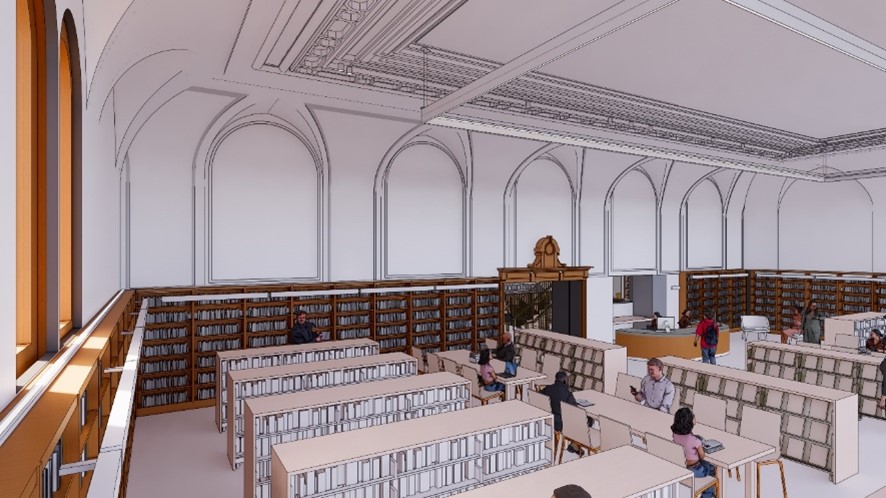
Proposal Exhibition Dates: April 20 – May 8, 2026
The San Francisco Arts Commission is conducting a review process to select an artist to design an artwork for the renovated Chinatown/Him Mark Lai Branch Library. The artwork will be installed into five arched niches, located along the west wall of the Library’s Historic Reading Room. Each niche measures approximately 9’4” x 6’6”, totaling approximately 300 square feet.
The goal of the project is to create an uplifting and inspiring atmosphere for library users and staff; creatively use the existing architectural features of the space; be an expression of the Chinatown neighborhood culture, history, identity, and values; and provide a community benefit, which includes providing an opportunity for artists with a meaningful connection to Chinatown.
Three artists have been selected as finalists by the Chinatown/Him Mark Lai Branch Library Artist Review Panel to develop conceptual proposals for this opportunity: Windy Chien, Bijun Liang, and Christine Wong Yap.
Please take a few minutes to review these artwork proposals and provide feedback. The proposals are available online at www.sf.gov/art-proposals-for-the-chinatown-him-mark-lai-branch-library-renovation-project , where you can leave feedback in the public comment form. Comments may also be submitted via email to sfacpublicartcomment@sfgov.org by Friday, May 8 at 5:00 p.m. PDT.
Public comments will be considered by the Review Panel as part of the Final Review Panel meeting where the Panel will recommend one proposal for implementation. Please note that public comments do not constitute a vote.
The Final Review Panel meeting will take place remotely the week of June 1, 2026. All Artist Review Panel meetings are open to the public. An agenda for the meeting will be posted 72 hours in advance of the meeting on SFAC’s website under the Public Meeting section: www.sf.gov/departments--arts-commission/events/upcoming
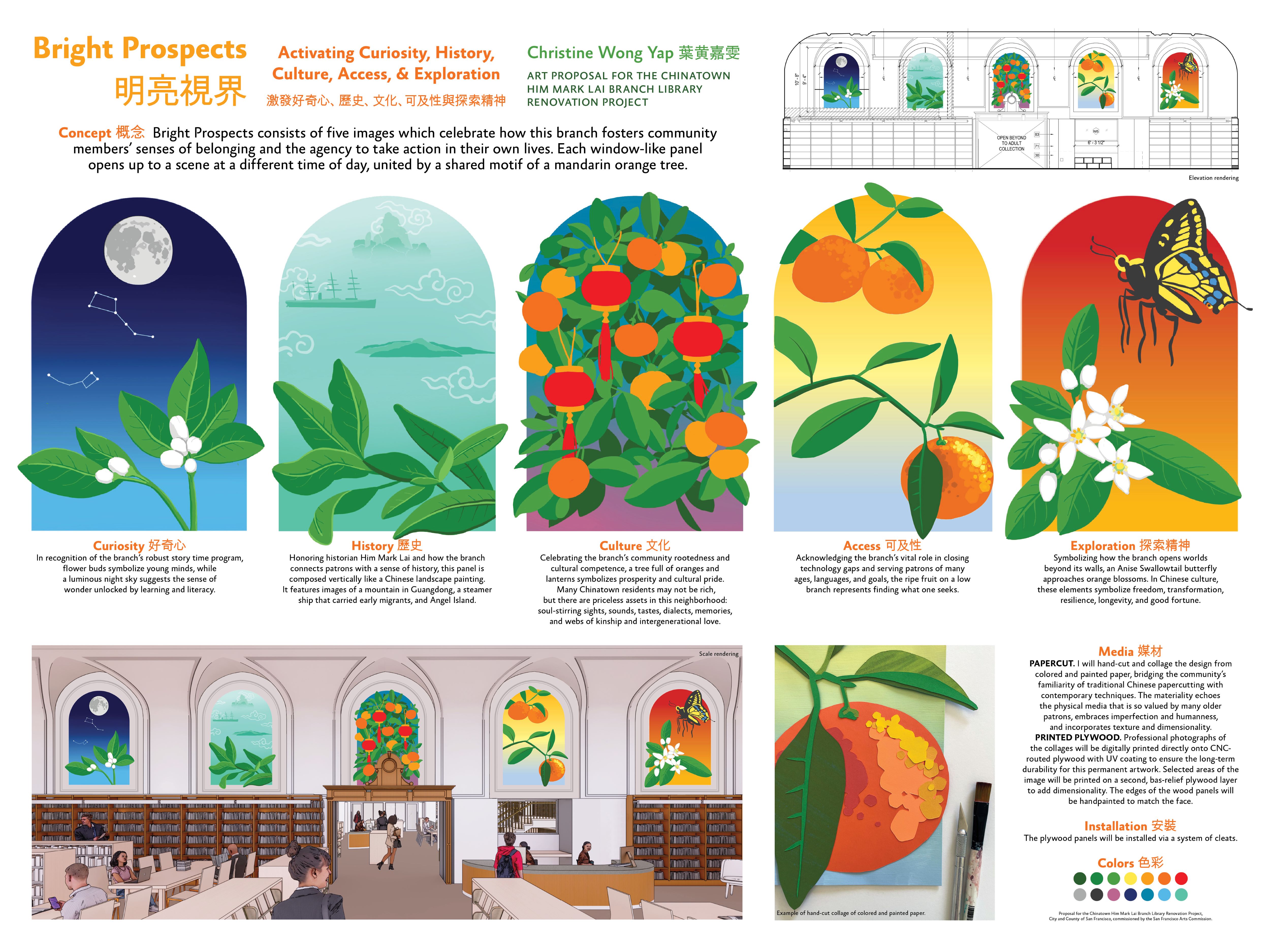
Bright Prospects: Activating Curiosity, History, Culture, Access, and Exploration / 明亮視界: 激發好奇心、歷史、文化、可及性與探索精神 by Christine Wong Yap 葉黄嘉雯
APPROACH
My approach is informed by two specific lived experiences. First, I worked with Him Mark Lai as an intern in the In Search of ROOTS program, which gave me hands-on experiences conducting research via oral histories and archives. This radically changed my senses of ancestry and identity, and helped me understand that history is something that any one of us can record. Second, when I would bring my elderly mother to this branch so she could access its Chinese language collections, I saw the impact of this branch, and the linguistic and cultural competence of its librarians, on the lives of patrons.
CONCEPT
Bright Prospects consists of five images which celebrate how this branch fosters community members’ senses of belonging and the agency to take action in their own lives. Each window-like panel opens up to a scene at a different time of day, united by a shared motif of a mandarin orange plant tree.
THEMES
- CURIOSITY: In recognition of the branch’s robust story time program, flower buds symbolize young minds, while a luminous night sky suggests the sense of wonder unlocked by learning and literacy.
- HISTORY. Honoring historian Him Mark Lai and how the branch connects patrons with a sense of history, this panel is composed vertically like a Chinese landscape painting. It features images of a mountain in Guangdong, a steamer ship that carried early migrants, and Angel Island.
- CULTURE. Celebrating the branch’s community rootedness and cultural competence, a tree full of oranges and lanterns symbolizes prosperity and cultural pride. Many Chinatown residents may not be rich, but there are priceless assets in this neighborhood: soul-stirring sights, sounds, tastes, dialects, memories, and webs of kinship and intergenerational love.
- ACCESS. Acknowledging the branch’s vital role in closing technology gaps and serving patrons of many ages, languages, and goals, the ripe fruit on a low branch represents finding what one seeks.
- EXPLORATION. Symbolizing how the branch opens worlds beyond its walls, a butterfly approaches orange blossoms. In Chinese culture, these elements symbolize freedom, transformation, resilience, longevity, and good fortune. Shown is an Anise Swallowtail, a SF Bay Area native that lays eggs in orange trees.
MATERIALS: PAPERCUT & PRINTED PLYWOOD
I will hand-cut and collage the design from colored and painted paper, bridging the community’s familiarity of traditional Chinese papercutting with contemporary techniques. The materiality echoes the physical media that is so valued by many older patrons, embraces imperfection and humanness, and incorporates texture and dimensionality.
Professional photographs of the collages will be digitally printed directly onto CNC-routed plywood with UV coating to ensure the long-term durability for this permanent artwork. Selected areas of the image will be printed on a second, bas-relief plywood layer to add dimensionality. The edges of the wood panels will be hand-painted to match the face.
View larger image here.
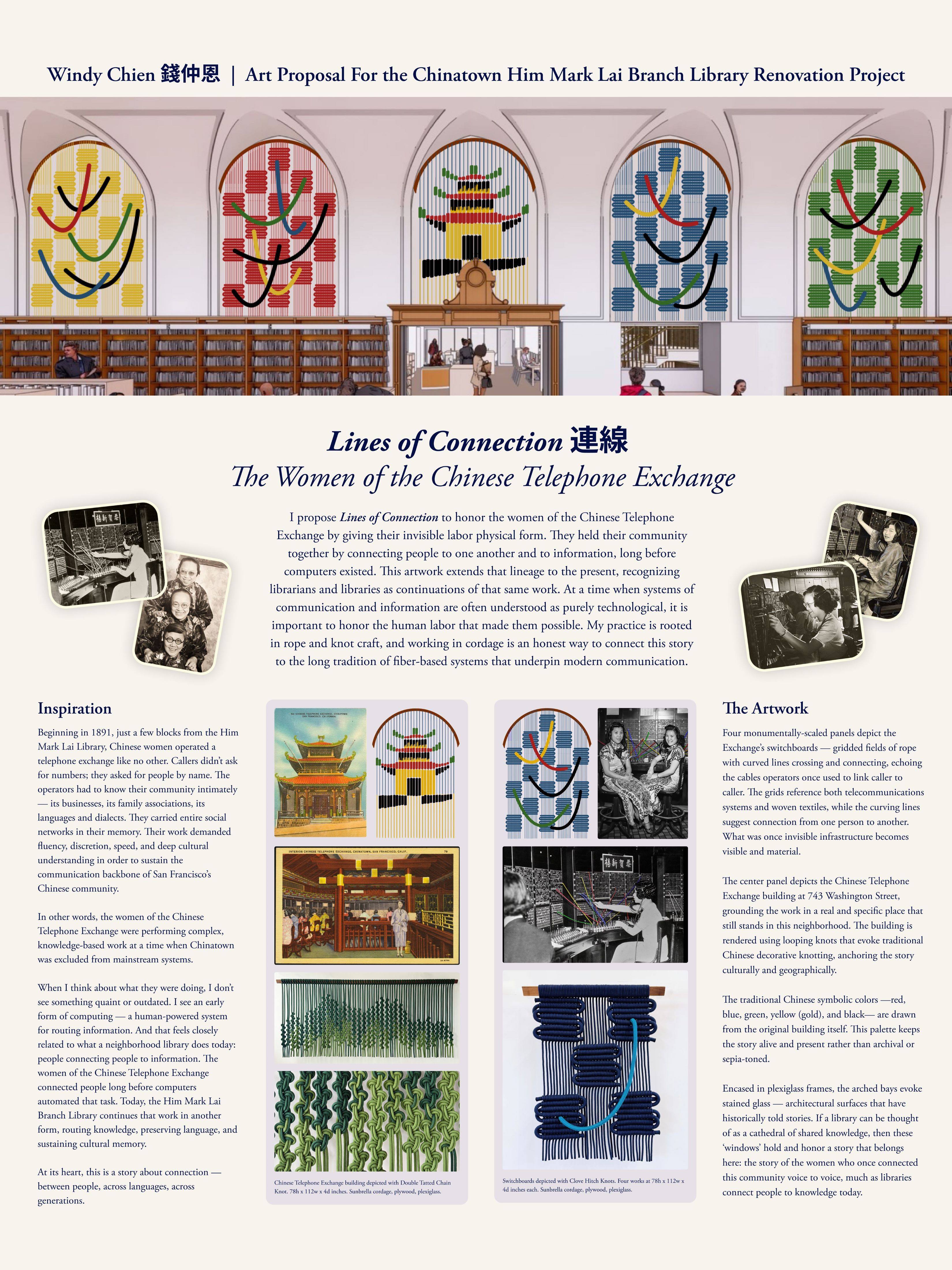
Lines of Connection 連線 The Women of the Chinese Telephone Exchange by Windy Chien 錢仲恩
Inspiration
Beginning in 1891, just a few blocks from the Him Mark Lai Library, Chinese women operated a telephone exchange like no other. Callers didn’t ask for numbers; they asked for people by name. The operators had to know the community intimately — its businesses, its family associations, its languages and dialects. They carried entire social networks in their memory. Their work demanded fluency, discretion, speed, and deep cultural understanding in order to sustain the communication backbone of the community.
When I think about what they were doing, I don’t see something quaint or outdated. I see an early form of computing — a human-powered system for routing information. They were the interface that connected the community.
And that feels closely related to what a neighborhood library does today: people connecting people to information. Today, the Him Mark Lai Branch Library continues that work in another form, routing knowledge, preserving language, and sustaining cultural memory. At its heart, this is a story about connection — between people, across languages, across generations.
The Artwork
Dimensions: Five works at 78h x 112w x 4d inches each
Materials: Sunbrella cordage (UV-resistant and waterproof), plywood, plexiglass
Lines of Connection fills the five arched window bays of the library with large-scale rope installations.
Four monumentally-scaled panels depict the Exchange’s switchboards — gridded fields of rope with curved lines crossing and connecting, echoing the cables operators once used to link caller to caller. The grids reference both telecommunications systems and woven textiles, while the curving lines suggest connection from one person to another. What was once invisible infrastructure becomes visible and material.
The center panel is a depiction of the Chinese Telephone Exchange building at 743 Washington Street, grounding the work in a real and specific place that still stands in this neighborhood. The building is rendered using looping knots that evoke traditional Chinese decorative knotting, anchoring the story culturally and geographically.
The traditional Chinese symbolic colors —red, blue, green, yellow (gold), and black— are drawn from the original building itself. The vibrant palette keeps the story alive and present rather than archival or sepia-toned.
Encased in plexiglass frames, the arched bays evoke stained glass — architectural surfaces that have historically told stories. If a library can be thought of as a cathedral of shared knowledge, then these ‘windows’ hold and honor a story that belongs here: the story of the women who once connected this community voice to voice, much as libraries connect people to knowledge today.
Why I Am Telling This Story
A recurring theme in my work is bringing visibility to “women’s work” — especially in moments when that labor supported technological progress but has been undervalued and overlooked by history. Early technology was simply people making things: craft. I’ve explored the female Navajo weavers who assembled early circuit boards for Silicon Valley, and the elderly weavers who made NASA’s Apollo-era core memory modules. Again and again, I am drawn to stories where women carried out highly meticulous, repetitive tasks using the skills of “women’s work.”
In fact, a 1936 newspaper article about a young Chinese Telephone Exchange operator, her job was described as “picking up the threads in this tapestry of life . . . and continuing the weaving.” That image has stayed with me.
My practice is rooted in rope and knots, one of the oldest technologies humans have developed and a universal language across all cultures. Working in cordage is an honest way to tell this story because it connects directly to a long lineage of fiber-based technologies that both predate and continue to underpin modern communication systems.
Lines of Connection memorializes the women of the Chinese Telephone Exchange by restoring their presence within the architecture of the neighborhood they helped sustain. It recognizes them not only as operators, but as builders of community infrastructure.
View larger image here.
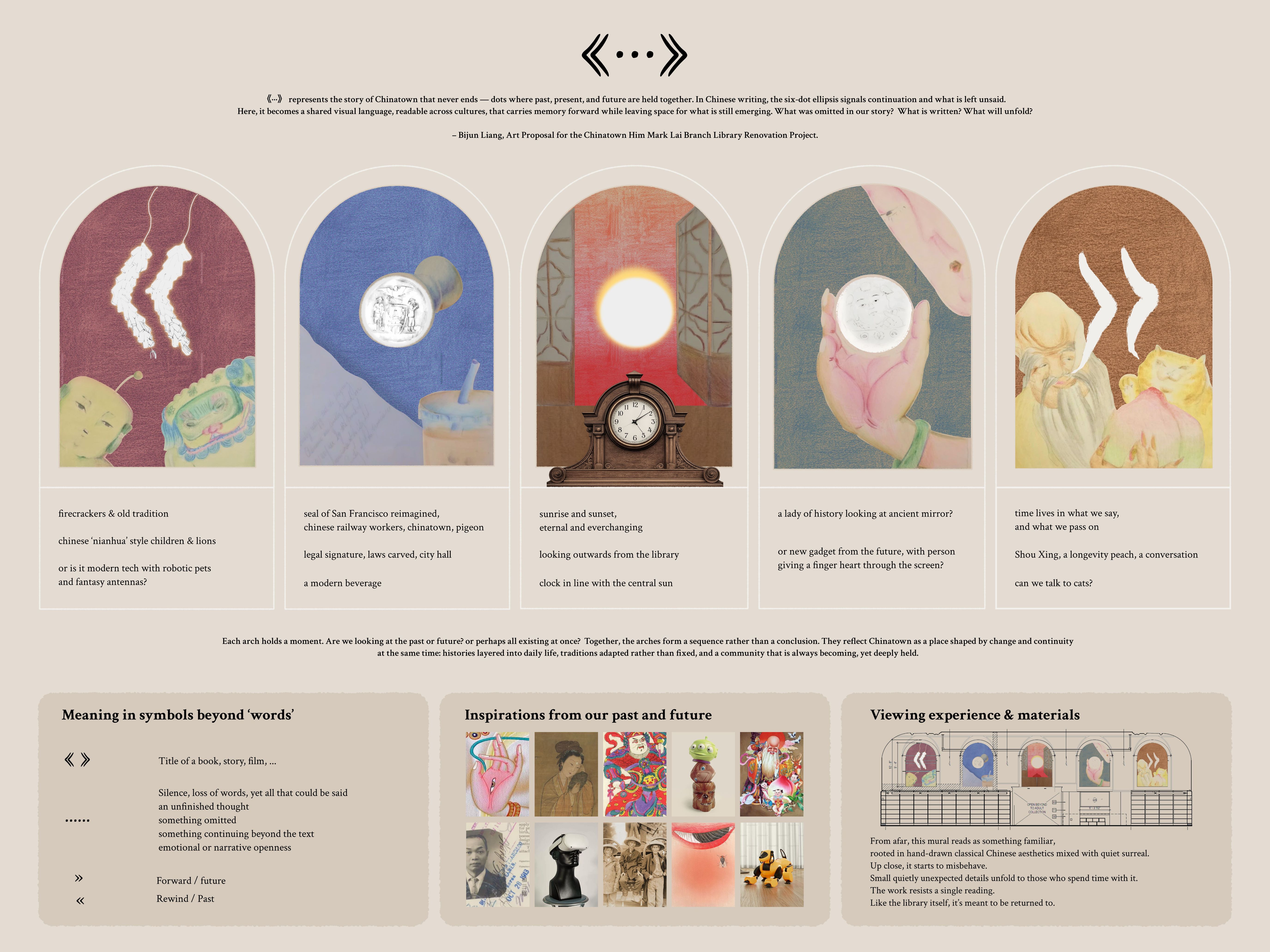
《···》by Bijun Liang
《···》 represents the story of Chinatown that never ends.
《···》 comes from the language of punctuation. In Chinese writing, the six-dot ellipsis holds what isn’t fully said. It is a pause, an omission, something continuing beyond the text. It leaves space for feeling, for memory, for what cannot be fully captured. Paired with directional brackets like 《 》, which suggest movement between past and future, these symbols become a quiet system for thinking about time. They reflect a story that is never complete, only carried forward. What was omitted in our story? What is written? What will unfold?
Each arch holds a moment, echoing the five marks of 《···》. Are we looking at the past or future? or perhaps all existing at once? Together, the arches form a sequence rather than a conclusion. They reflect Chinatown as a place shaped by change and continuity at the same time: histories layered into daily life, traditions adapted rather than fixed, and a community that is always becoming, yet deeply held.
Hopes for the Community
I immigrated to San Francisco Chinatown with my single mom when I was five, and have been rooted here ever since. I spent much of my childhood in this library, where I first connected with stories through novels, manga, and, honestly, a fair amount of online games (thanks library computers).
Today, my family still lives and works in the neighborhood, and my art is shaped by the resilience I see here every day.
This mural is meant to hold space for Chinatown’s complexity. To me, its story has always been shaped by people arriving, making space where there was none, and rebuilding again and again. You can see it in everyday life, and in the ways people have pushed through systems that tried to exclude them and still found ways to belong. Not everything is recorded, but it continues forward all the same. 《···》 reflects both this history and what carries on.
I hope the work feels familiar at first glance. And if you stay a little longer, something small catches your eye, something just slightly off, in a good way.
I hope it gives people a reason to pause, or to come back another day.
View larger image here.
Share your feedback
Please take a few minutes to review these artwork proposals and provide feedback. The proposals are available online at www.sf.gov/art-proposals-for-the-chinatown-him-mark-lai-branch-library-renovation-project , or accessed by the QR Code below, where you can leave feedback in the public comment form. Comments may also be submitted via email to sfacpublicartcomment@sfgov.org by Friday, May 8 at 5:00 p.m. PDT.Share your feedbackAbout
For more information, please contact: sfacpublicartcomment@sfgov.org, or (415) 252-2100. Materiales traducidos están disponibles para usted de manera gratuita. Para asistencia, notifique a sfacpublicartcomment@sfgov.org, or (415) 252-2100. 我們將為閣下提供免費的書面翻譯資料。 如需協助,sfacpublicartcomment@sfgov.org, or (415) 252-2100. Ang mga materyales na nakasalin sa ibang wika at ang mga serbisyong tagapagsalin sa wika ay walang bayad. Para sa tulong, maaring i-contact si sfacpublicartcomment@sfgov.org, or (415) 252-2100.