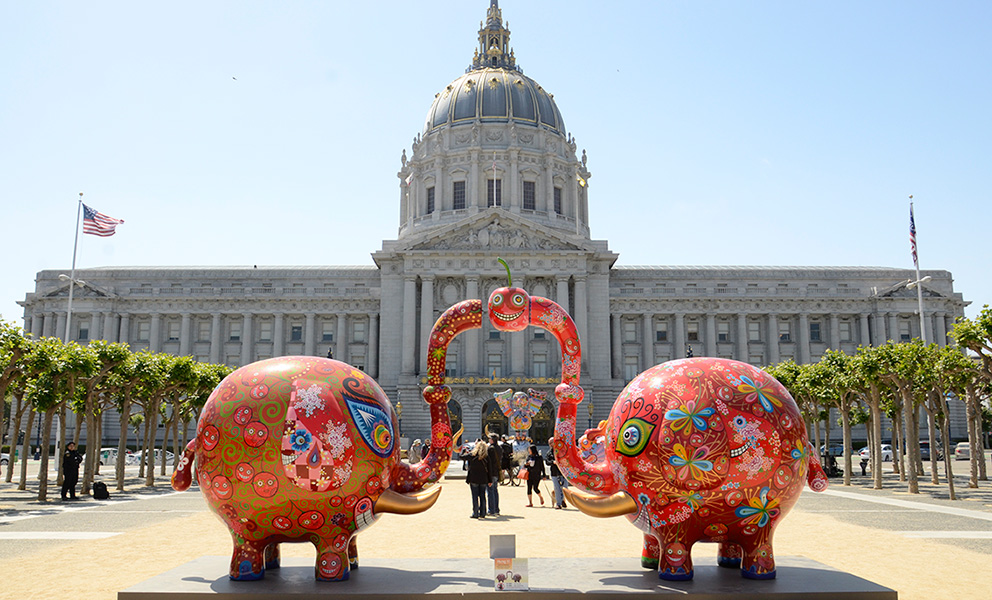
Civic Center Plaza: Hung Yi, Fancy Animal Carnival, 2015
The Arts Commission must approve the temporary or permanent installation of any work of art on City and County of San Francisco (CCSF) property, or any proposal funded in whole or in part by City funds (regardless of its proposed location).
This includes proposals initiated or funded by other City departments, or by outside sponsors, such as individual artists, organizations or commercial enterprises. In considering approval, the Arts Commission must evaluate proposals within the context of its mission to promote a rich, diverse, and stimulating cultural environment for the city’s residents, visitors and employees, and to enhance the city’s image both nationally and internationally.
For questions, please contact Paris Cotz, Program Associate, Special Initiatives and Civic Design, paris.cotz@sfgov.org, (415) 539-6213.
Note: With the exception of funds awarded on a competitive basis through its various programs, the Arts Commission cannot provide financial or staff support for the project. It is incumbent on the project sponsor to cover all costs associated with the project.
- The artwork should be appropriate for a diverse audience.
- There should be a compelling reason to site the exhibition on City property, such as the relevance of the exhibit within the natural, architectural, cultural, historical, social/political or environmental context of the site.
- Artwork should, have merit as a work(s) of art, independent of other considerations.
- The exhibition of the artwork should be judged to enhance the public’s experience of the site.
- The exhibition should be an opportunity to expose the public to diverse artists and artistic styles.
- The exhibition should not contradict the City’s values of environmental sustainability, accessibility, and cultural inclusiveness.
- Exhibitions proposed should be appropriate in scale, media and context with its intended display location.
- There is evidence that the exhibition has community support.
- The artwork should be judged to be able to withstand unprotected display in an outdoor environment, and be able to be maintained by the sponsor throughout the public display period.
- The exhibit must not present a safety hazard. It must comply with all applicable building codes and disability access requirements.
- The proposed exhibit must be evaluated to be feasible, with convincing evidence of the sponsor’s ability to mount the exhibit as proposed. Factors to be considered include, but are not limited to: timeline, the artist’s experience, soundness of materials, The proposed exhibit must not impede the typical uses of the site.
- Project sponsors must pay all costs associated with the exhibit, including any Arts Commission staff time involved in assisting the sponsor with the exhibit, any required insurance, and permit fees.
- Artwork should be of representative of highest aesthetic standards, and have merit as a work(s) of art, independent of other considerations.
- The exhibition of the artwork should be judged to enhance the public’s experience of Civic Center, and enhance the city’s cultural profile and prestige.
- The exhibition should be an opportunity to expose the public to diverse artists and artistic styles. Exhibitions in the Civic Center environs should not only emphasize Bay Area artists, styles and movements, but also present the work of artists who are nationally and internationally renowned so that local culture may be seen within a global context.
- As the exhibition may be seen to reflect on the entire Civic Center complex, project sponsor must provide the Commission with evidence of community support, including that of the Mayor’s office, Main Library and Asian Art Museum.
- The artwork should be judged to be able to withstand unprotected display in the Civic Center environment which is characterized by strong winds.
Temporary public art projects are artworks that are installed for a defined, limited duration and are not intended to be permanent or become part of the City’s Civic Art Collection.
Unless otherwise approved by the Arts Commission, temporary artworks are typically approved for an initial display period of up to one year.
Step by Step
- Determine Installation Site Property Owner
Determine the owner of the property you have selected for your installation site. Will your project take place on city property or private property, or public property under the jurisdiction of another governmental agency? Determining this is the responsibility of the project sponsor. Arts Commission staff cannot assist in identifying a location for the installation.
How to Determine if Arts Commission Approval is Needed:
2. Prepare a proposal for Arts Commission Review
Please submit the following:
Longer-Term Temporary Installations
In some cases, project sponsors may propose a temporary artwork for a display period longer than one year. These proposals are reviewed on a case-by-case basis and may be appropriate for projects that serve an ongoing cultural, civic, placemaking, or community-driven purpose.
For installations proposed for multi-year display (e.g., 3–5 years), additional documentation may be required, including:
- A detailed maintenance and stewardship plan
- Identification of the responsible party for maintenance, conservation, and repairs
- Proof of insurance coverage if required by the host site or partnering agency.
- An annual condition review submitted to SFAC staff
- Confirmation of site permissions and agency coordination for the full duration
- A clear removal and site restoration plan at the end of the term
- Project sponsors are responsible for the removal of the artwork and restoration of the site at the conclusion of the approved display period unless otherwise authorized by the Arts Commission. Any costs associated with removal and site restoration are the responsibility of the project sponsor. Temporary artworks approved for extended display periods remain classified as temporary installations and are not automatically eligible for acquisition into the City’s permanent Civic Art Collection.
3. Approval Process and Schedule
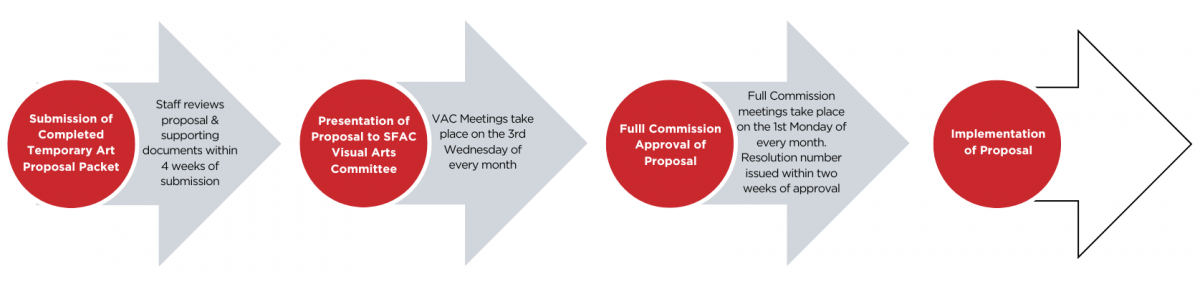
You may be asked to meet with staff to further explain or clarify your proposal. Please submit proposal 2.5 months in advance of Visual Arts Committee approval (third Wednesday of the month).
Submit proposal package outlined in Step 2 for review by Commission staff. Submissions may be directed to:
Paris Cotz
paris.cotz@sfgov.org
(415) 252-2252
Schedule an appointment with SFAC staff to discuss your proposal here:
bit.ly/SFACTempArt
Your proposal will be reviewed by Arts Commission Staff. You may be asked to meet with staff to further explain or clarify your proposal.
SFAC Staff will place the completed proposal package on the agenda for the Arts Commission’s Visual Arts Committee, a subcommittee of the full Arts Commission for review. For temporary sculpture installations, you will be asked to present your item in person. This committee meets on the third Wednesday of each month at San Francisco City Hall.
If the proposal is approved by the Committee, the item will be placed on the agenda for the Full Arts Commission for approval by Resolution. Arts Commission approval is complete when the Full Arts Commission approves the project by Resolution. The Full Arts Commission meets on the first Monday of each month at San Francisco City Hall, Room 416.
The installation of the artwork may not occur until after Full Arts Commission approval.
*Exceptions to the rule... - Installations lasting less than 7 days may be approved by the Director of Cultural Affairs and do not need to be calendared for approval by resolution of the Commission.
- Installations proposed for San Francisco International Airport: The Arts Commission does not handle inquiries or proposals for the San Francisco International Airport. The SFO Museum has a robust curatorial program. Inquiries should be directed to curator@flysfo.com.