On this page
- STI recent trends
- STI monthly reports
- STI annual summaries
- More local data (mpox, HIV, historical STI data)
- State and national data
STI recent trends
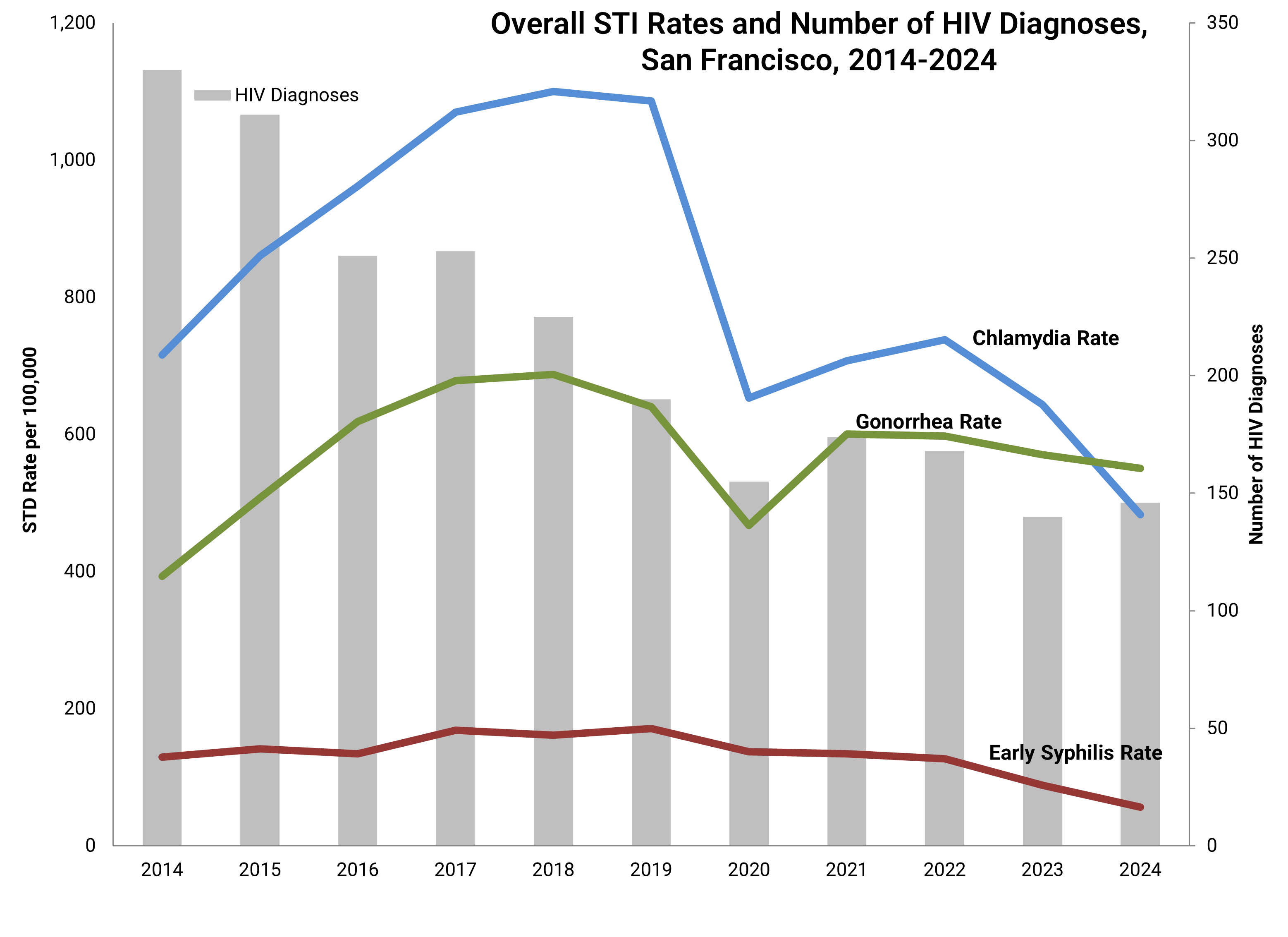
From 2023 to 2024, the number of new HIV diagnoses in San Francisco increased by 4%; the number of chlamydia diagnoses decreased by 25%, early syphilis diagnoses decreased by 36%, and gonorrhea diagnoses decreased by 3%.
San Francisco was one of the first urban centers to see declines in new HIV diagnoses. These decreases were due to citywide efforts to scale-up HIV testing and early and widespread HIV treatment, a strong linkage-to-HIV care program (provided by the SFDPH LINCS team), and access to syringes, condoms, and PrEP (pre-exposure prophylaxis for HIV) (source: see "References" below).
New HIV diagnoses declined by 55% from 326 in 2014 to 146 in 2024 (source: HIV Epidemiology Annual Report 2024 San Francisco).
In contrast, rates of syphilis, chlamydia, and gonorrhea increased each year from 2014 to 2018. There was a sharp decline in STI diagnoses in 2020 attributed to COVID-19 impacts on health care services. STI rates never returned to the levels seen in the years immediately preceding the introduction of COVID-19 and began to decline since the October 2022 release of citywide guidelines for doxycycline post-exposure prophylaxis (doxy-PEP) for STI prevention (source: JAMA: Doxycycline Postexposure Prophylaxis and Sexually Transmitted Infection Trends). Chlamydia and early syphilis rates in 2024 are the lowest seen since 2006 and 2007, respectively (with the exception of 2020). Doxy-PEP is less effective at preventing gonorrhea as compared to chlamydia and syphilis, reflected in a more limited decline in gonorrhea rates since 2022.
5-year comparisons in the number of cases are provided for each STI below, reflecting changes between 2020 and 2024. Comparisons should be interpreted within the context of disrupted health services and changes in health behaviors in 2020. More recent comparisons (changes between 2022 and 2024) better reflect STI trends in San Francisco than rates seen during the COVID-19 pandemic.
Syphilis trends
- In 2024, 85% of new early syphilis cases in San Francisco were among men, the majority of whom identified as gay or bisexual, or reported having sex with a man.
- From 2020 to 2024, there was a 49% decrease in total syphilis diagnoses in men (1,421 to 718) and a 4% decrease in total syphilis in women (160 to 153).
- Between 2020 and 2024, there were 20 total congenital syphilis cases in SF, a 150% increase compared to the 8 cases in the prior 5 years (2015-2019).
Chlamydia trends
- The number of chlamydia cases decreased by 26% (5,707 to 4,219) in San Francisco between 2020 and 2024.
- Adolescent and young adult women experience disproportionate rates of chlamydial infection, more so among Black/African American youth. There are multiple factors that contribute to these persistent disparities.
Gonorrhea trends
- Between 2020 and 2024, the number of gonorrhea cases increased by 17% (4,086 to 4,811) in San Francisco but has decreased by 8% since 2022.
- In 2024, 70% of gonorrhea infections among males in San Francisco involved the rectum or pharynx (throat).
References
- Association of state-level PrEP coverage and new HIV diagnoses in the USA from 2012 to 2022: an ecological analysis of the population impact of PrEP - The Lancet HIV
- HIV treatment-as-prevention and its effect on incidence of HIV among cisgender gay, bisexual, and other men who have sex with men in Australia: a 10-year longitudinal cohort study - The Lancet HIV
- The Impact of ACA and Medicaid Expansion on Progress Toward UNAIDS 90-90-90 Goals | Current HIV/AIDS Reports | Springer Nature Link
- Development of a Citywide Rapid Antiretroviral Therapy Initiative in San Francisco - PubMed
- Decreased Time From Human Immunodeficiency Virus Diagnosis to Care, Antiretroviral Therapy Initiation, and Virologic Suppression during the Citywide RAPID Initiative in San Francisco - PubMed
- Effectiveness of structural-level needle/syringe programs to reduce HCV and HIV infection among people who inject drugs: a systematic review - PubMed
- HIV Infection Risk, Prevention, and Testing Behaviors Among Men Who Have Sex With Men—National HIV Behavioral Surveillance, 19 U.S. Cities, 2023
STI monthly reports
2026
August 2026
Special topic: Bicillin L-A expiration dates extended for some lot numbers as nationwide shortage continues
July 2026
Special topic: 2024 San Francisco STI Annual Summary Report Now Available
June 2026
Special topic: 2024 San Francisco STI Annual Summary Report Now Available
May 2026
Special topic: First cases of clade I mpox in SF
April 2026
Special topic: First cases of clade I mpox in SF
March 2026
Special topic: Penicillin G Benzathine (Bicillin L-A) Shortage Continues
February 2026
Special topic: TMVII Identified in San Francisco
January 2026
Special topic: Penicillin G Benzathine (Bicillin L-A) Shortage Continues
2025
The monthly reports for January 2025 through June 2025 include errors in the Table 2 rates. All other information in each of those monthly reports is accurate as of the date of publication.
The monthly reports for January 2025 through November 2025 included only HIV rapid tests and 4th generation HIV tests in the total “Tests” count in Table 3. Starting in December 2025, the row for total “Tests” also includes pooled RNA tests.
December 2025
Special topic: San Francisco citywide cases of chlamydia, gonorrhea and syphilis continue to decline in 2025
November 2025
Special topic: SF City Clinic has a new website: sf.gov/cityclinic
October 2025
Special topic: San Francisco Releases 2024 HIV Epidemiology Annual Report
September 2025
Special topic: SF City Clinic has a new website: sf.gov/cityclinic
August 2025
Special topic: Lenacapavir now approved for long-acting injectable PrEP
July 2025
Special topic: Penicillin G Benzathine (Bicillin L-A) Recall and Shortage
June 2025
Special topic: Penicillin G Benzathine (Bicillin L-A) Recall and Shortage
May 2025
Special topic: Meet the STI/HIV LINCS Team!
April 2025
Special topic: Introducing the Umoja Health Access Point
March 2025
Special topic: 2024 HIV Preliminary Annual Surveillance Report now available
February 2025
Special topic: Follow Us for STI Awareness Week April 13-19th
January 2025
Special topic: Expanded Syphilis Screening Recommendations and Resolution of Benzathine Penicillin G Shortage
2024
The monthly reports for January 2024 through November 2024 have been removed due to errors. The December 2024 report has been corrected and updated, still providing totals for 2024.
December 2024
Special topic: 2024 data show decreases in bacterial STIs in San Francisco, but disparities persist
2023
December 2023
Special topic: 2023 data show decreases in bacterial STIs in SF but disparities persist
November 2023
Special topic: Mpox Cases Among SF Residents
October 2023
Special topic: SFDPH Releases 2022 HIV Epidemiology Annual Report
September 2023
Special topic: National Penicillin G Benzathine (Bicillin L-A) Shortage Continues
August 2023
Special topic: Increase in Mpox Cases Among SF Residents
July 2023
Special topic: Increase in Mpox Cases Among SF Residents
June 2023
Special topic: National Penicillin G Benzathine (Bicillin L-A) Shortage
May 2023
Special topic: Risk of Mpox Resurgence
April 2023
Special topic: National Penicillin G Benzathine (Bicillin L-A) Shortage
March 2023
Special topic: Risk of Mpox Resurgence
February 2023
Special topic: Doxy-PEP is here!
January 2023
Special topic: Increase in Extensively Drug-Resistant Shigellosis in the United States
State and national data
About
These data and reports are a joint effort of Applied Research, Community Health Epidemiology, and Surveillance (ARCHES) and the STI/HIV Branch, home to San Francisco City Clinic.
Both are branches of the Population Health Division of the San Francisco Department of Public Health.
Contact information
Address
Suite 500
San Francisco, CA 94102