Report
Tuberculosis in City and County of San Francisco, 2023

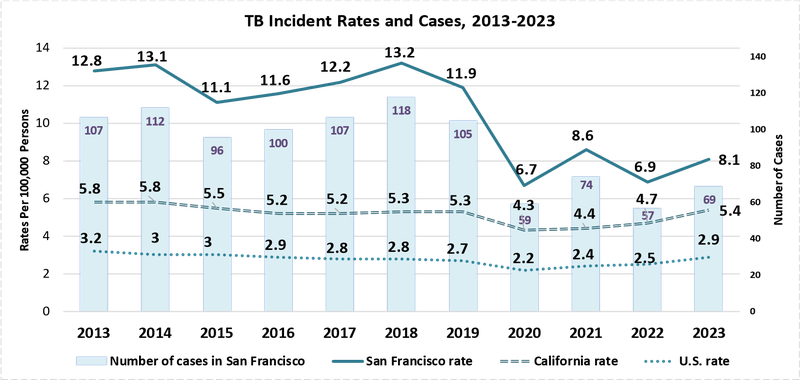
The mission of San Francisco Tuberculosis Prevention and Control Program is to control, prevent, and finally eliminate tuberculosis in San Francisco by providing compassionate, equitable, and supportive care of the highest quality to all persons affected by this disease. In 2022, 57 new cases with active tuberculosis (TB) were reported in San Franciscans (6.9 cases per 100,000 persons). The rate of TB in San Francisco is nearly triple the national rate of 2.5 cases per 100,000 persons, and 1.5 times the California rate of 4.7 cases per 100,000 persons.
Demographics
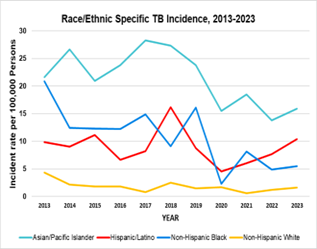
In 2022, San Francisco reported 51 cases among non-U.S.-born residents and an incidence rate of 17.8 cases per 100,000 persons, compared with 6 U.S.-born residents and an incidence rate of 1.1 cases per 100,000 persons. In terms of race/ethnicity, Asian/Pacific Islander residents had the highest TB incidence rate reported (13.8 cases per 100,000 persons), which was nearly 12 times the rate among Non-Hispanic White residents (1.2 cases per 100,000 persons). Incidence rates were 6.5 times higher among Hispanic/Latino residents and more than 4 times higher among Non-Hispanic Blacks compared with Non-Hispanic White residents
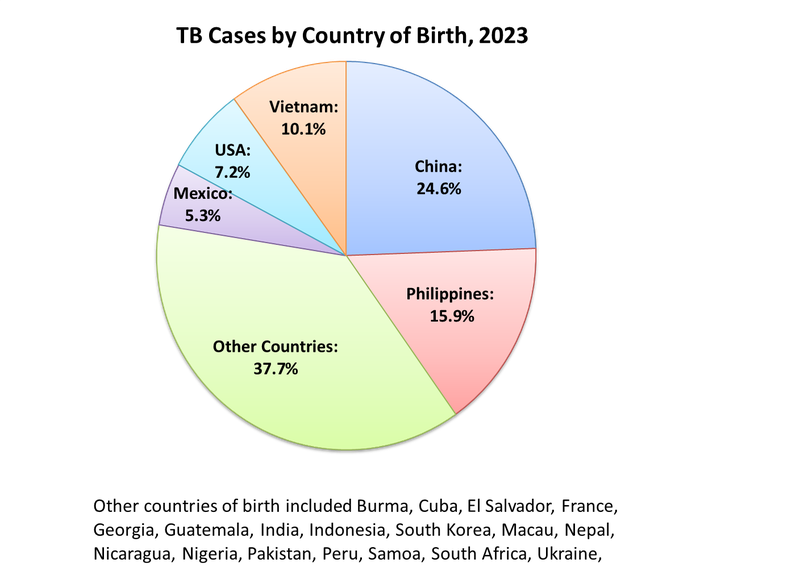
Among 57 cases reported in 2022, 35 (61.4%) were identified in male residents. The median ages in years at time of TB reporting were 64 in 2018, 63 in 2019, 62 in 2020, 66.5 in 2021 and 61 in 2022 (range: 14-89 years). One pediatric case (0-14 years old) was reported, and 45.6% of the cases were reported ages 65 and older. The country of birth among San Franciscans with TB disease was diversely represented. Other country of birth included Brazil, El Salvador, Guatemala, Honduras, India, Malaysia, Mongolia, Republic of Korea, Ukraine, and Uzbekistan.
Site of Disease
In 2022, 36 cases were pulmonary TB, 2 were pleural TB, 10 were other extrapulmonary TB, and 8 were both pulmonary and extrapulmonary TB. Other extrapulmonary sites included lymph node (cervical, axillary, and mediastinal), liver, spleen, ileum, manubriosternal joint, spine, eye, peritoneum, genitourinary system, and central nervous system.
Comorbidities and Risk Factors
Two or more medical comorbidities were present in 39 of 57 residents with a reported case of TB. Specifically, 13 cases (22.8%) had diabetes mellitus, 12 (21.1%) had viral hepatitis, 7 (12.3%) had chronic kidney disease, and 16 (28.1%) had immunocompromise (HIV and non-HIV). Additionally, 7 (12.3%) were experiencing homelessness, 5 (8.8%) had heavy alcohol use, and 4 (7.0%) had substance abuse within the past 12 months prior to the TB diagnosis.
Mortality
At the time of this publication, there were 11 deaths among San Francisco residents with a case of TB reported in 2022, representing an 19.3% mortality. Two died before TB diagnosis, and 9 deaths were directly related to TB disease.
Drug Resistance to Standard Medications
The proportions of drug resistance remained low. Four cases were mono-resistant to isoniazid, 1 case was mono-resistant to pyrazinamide, and 1 case was resistant to isoniazid and pyrazinamide. No multidrug resistant TB (resistant to isoniazid and rifampin) was reported in 2022.